

GraduateQuant @GraduateQuant
London, England Joined July 2024-
Tweets74
-
Followers20
-
Following500
-
Likes379
Trying to learn rhombus (@racketlang) lately, the control flows syntax is so elegant and intuitive: docs.racket-lang.org/rhombus-guide/…


- test should be considered part of the program - the same for properties - PBT and runtime checks should be able to be derived from props - var name should be considered part of the doc. Docstring should not repeat what is already implicated by the var name.

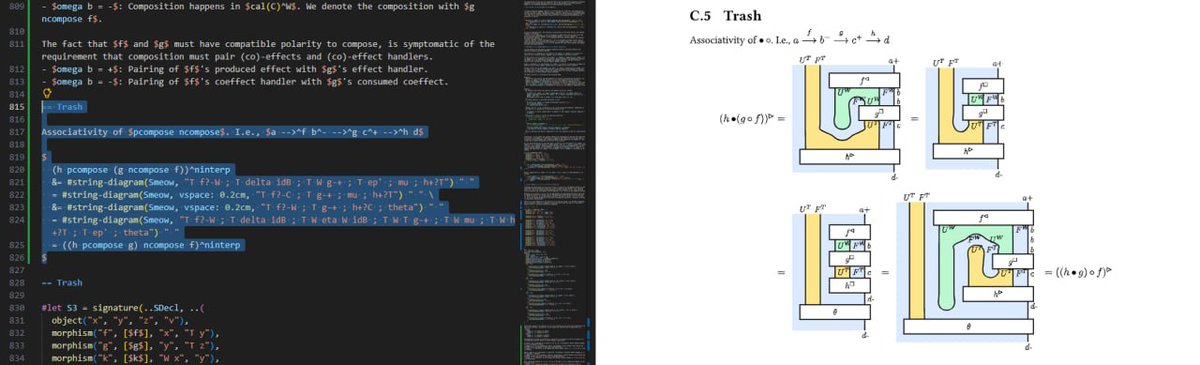
@NoahChrein ive been writing all my rough stuff in typst. also i have a string diagram generator for on-the-fly working
@leostera Isn't this just OCaml [Gospel](github.com/ocaml-gospel/g…)?
the only thing I one-shotted on Codex Plus plan is the 5 hour usage limit.
no one: claude: BSD sed has no \b, so the rename didn't apply. Redoing it with perl. well actually, might just be my skill issue
Maybe I’m wrong, but I believe dependent types are a great fit for low-level programming because correctness there is relatively stable and easy to express formally. High-level features are different beasts. How do you formalize something like “Send no more than three notifications per day, except for urgent events”, let alone verify it? Things close to the business end are unstable in both meaning and priority. There is a case to be made for decoupling types and properties here. We can’t capture all the invariants we want, but we can choose to put some of what we can in types, some in properties, and we can leverage many existing tools to give us sufficient assurance. This is not to say dependent types are not worth it at high levels, though. I just think they need a friend in a separate proof system, ideally built into the same language.

@statusfailed I disagree with both of these claims. You can have what is essentially raw assembly + a type system. I have friend working on intrinsically typed / correct by construction compiler optimization and being able to write correct by construction MIPS is part of this.
I need a word to describe: "I saw a bug. I don't understand the bug. LLM came up with a fix I don't understand either. But it fixed the bug." I really don't want to waste reviewer's time and make them think that I'm an idiot when attaching a gen-ai fix in a bug report.
I wonder what proxy they will come up to model the readability of codebase (not just code, but also a readable architecture design). Using Fable to evaluate Opus's code is definitely not good, because Fable has no issues with overused jargon and putting changing log in comments.
I think today's time is the turning point for AI labs to optimize for human communication rather than some "task"-related benchmaxxing in model training. The cost-benefit structure has made trading off readability for unreadable code golf not reasonable anymore.
其实仔细想想, 我的恐惧是由于我过度神圣化了书本. 我幻想只要一页一页读完, 我就一定会获得什么. 我至少可以说"我读完了XXX". 我可以划掉这本书不再读. 一些证据: - 我对paper也有类似的恐惧. 但是没有书来得多 - 我很少重读书 因为我觉得"读完了"
I am resistant to use LLM to help me read a book. I have fear that if I don't read it from cover to cover, I'll get lazy and disrespect the knowledge and the author. I just tried. It's good and efficient. I should probably do that more often. It's a skill to learn.
Bash Pitfalls: <mywiki.wooledge.org/BashPitfalls>
Google Shell Style Guide: <google.github.io/styleguide/she…>

@spikedoanz Just curious, what other languages would you recommend as an alternative?

this critique is unfair because "computer science" as a field is less of a single field and more like at least 3 loosely overlapping domains: 1. (computer) science: the study of the actual machines we have: CPUs, caches, memory, networks, operating systems, databases, compilers, and algorithms. this is mostly the world of the von neumann machine, and roughly what an undergraduate CS curriculum centers on. 2. theoretical (computer science): complexity theory, information theory, turing machines, quantum computing, lambda calculus, and type theory. this is the mainstream mathematical theory of computation, and probably the part most criticisms of “computer science” are aimed at. 3. (theoretical computer) science: proof theory, category theory, philosophy, linguistics, and to a large extent just general mathematics. not many really know about it, and it's also just generally really hard because you start needing to know graduate level mathematics. topology, abstract linear algebra, functional analysis, differential geometry, ... are very often used. "computers" in this case don't necessarily mean "equivalent to turing machines" anymore, and often times are intentionally weakened to obtain better structural properties (ala Lafont's interaction combinators). furthermore, it is the upstream of most domain shifting ideas in computer science. to say that "computer science" only studies things like turing machines ignores an incredibly important and unusually generative part of the field borrow checking? linear logic, via girard. types? proof theory, via gentzen and curry–howard. monads and algebraic effects? category theory and universal algebra, via lawvere, moggi, wadler, and many others. so complaints about “computer scientists” usually need several asterisks. the field is not just intellectually fragmented, it's also sociologically fragmented! these communities often publish in different venues, use different standards of evidence, require different mathematical backgrounds, and are sometimes housed in entirely different departments.

Computer science is a weird field. It’s literally an entire field based around the operation of a particular machine. It's the equivalent of saying "piston-based internal combustion scientist" instead of mechanical engineer. There are so many other ways to build a "computer".

Ok, this is in fact amazingly good. claude.ai/share/1caa35ab…

Underrated LLM use case: if you have an expert conversation in almost any context you can feed a transcript/notes to an LLM and ask some variant of “What didn’t they tell me” to explore around space at higher level than you’d have access to w/o the expert’s seed context.
I don't understand why the migration target is Python (Python is my main language btw). I'd at least choose a language with ADT. OCaml? Scala? The conclusion might mean that Haskell was the wrong choice at the very beginning. LLM only makes correcting this error easier.


What I wrote on our internal Zulip:


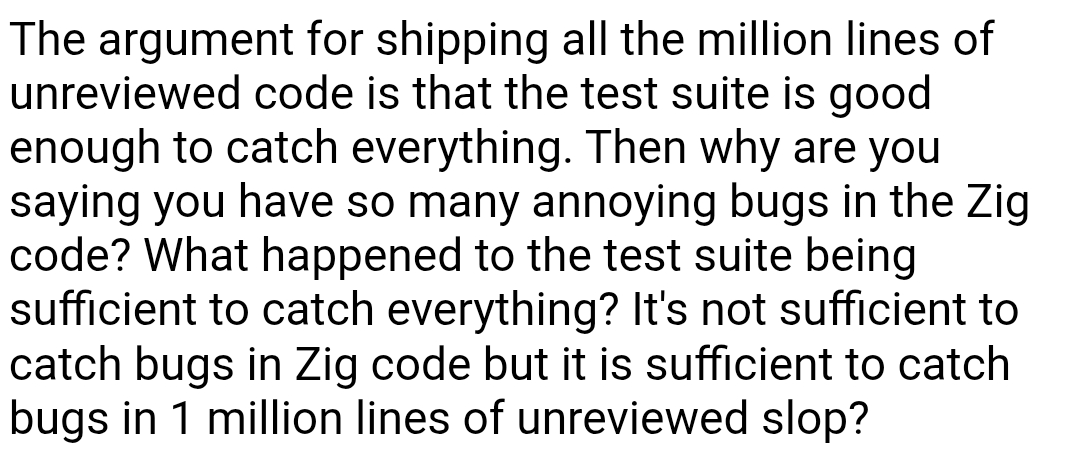
Andrew's post about the Bun Rust rewrite unfortunately starts off way too emotional. But this is a fantastic point made inside the article (Sadly it comes after many paragraphs of personal attacks, but it is a very valid point)


Andrew Shu @0xAndrewShu
124 Followers 2K Following We all underuse agents. Improving your productivity @Branchmore by finding token and other waste. Ex-Dir Eng @PermisoSecurity, CTO @Printivity. https://t.co/Di7LM3QgiI.

luna 💗 @Shadow8_30
13 Followers 289 Following
Frank Hoffmann @15r10nk
328 Followers 270 Following 🚀 having fun living this one life ⚒️ python tooling ⏰ hacking time 👧 being a proud father

Lara Garrido @laragarridc3l
6 Followers 259 Following 🦋 21 and not here for boring chats 🌺 • 🌞 • calm energy

@_@ @dysinger
5K Followers 1K Following ❚ 🇺🇸 ❚ 1A ❚ 2A ❚ 🏋️ DYEL ❚ 태권도 ❚ 碁士 ❚ 🤖 SR² CTO|SWE|SRE ❚ ∀ Lean ❚ ⭐ FStar ❚ ❄️ NIX ❚ 📻 WM7E ❚ 🛜 802.11AH (LoRa) ❚ DARVO Observer
Scott Evernden @yay3d
2K Followers 1K Following Creature Director. Building 🤖 Eric Robot-790: a fun companion robot with personality, imagination, memory and an inner dialog. MIT / Media Lab / DEC R&D.

Daulet @Daulet65
8 Followers 197 Following AI Practitioner, Optimist; Tweeted thoughts are mine, and not my employers
Thomas Kelly 🇻🇦... @Thomasmarkelly
1K Followers 7K Following DYOR I see the issue now! I am humbled and super excited to announce that you are absolutely right! Rt not = agree
Phil @phil__65
105 Followers 3K Following
DevOops @simuran
148 Followers 3K Following
Arplaworkup @Arplaworkup539
39 Followers 408 Following
Oboutci @Oboutci738502
20 Followers 470 Following
Beesaw @Beesaw2198
38 Followers 2K Following

Neil Mitchell (neildm... @ndm_haskell
5K Followers 163 Following Haskell/Rust programmer. Views expressed are my own.

Daniel Sainati @sainati_
116 Followers 156 Following Programming Languages PhD Student @CIS_Penn. Formerly @flow_blockchain, @flowtype. @Cornell CS ‘18
Lior Pachter @lpachter
84K Followers 2K Following Bren Professor of Computational Biology @caltech. Blog at https://t.co/FFQzhEsmhi. Tweets represent my views, not my employer's. #methodsmatter
Nintendo .DS_Store @sliminality
11K Followers 184 Following Please do NOT grotesquely misrepresent what I said in this manner.
wintensional equality @plt_dril
1K Followers 0 Following 'flawless agda noscope'. the crowd goes wild...


Ryan Lopopolo @_lopopolo
11K Followers 1K Following Principal Engineer, Agentic GCP @googlecloud • prev @OpenAI • Building the future of work. Harness engineering. As an agent influencer, • opinions mine


Jesper Munkeby @JesperMunkeby
242 Followers 427 Following Malleable software and eventual consistency
sergey bratus @sergeybratus
6K Followers 2K Following The cat is the Otocolobus Manul, https://t.co/Xswt7Vp2F1 . Manul is the perfect privacy mascot. All views & opinions are my own & personal.
The Haskell Interlude @HaskelInterlude
670 Followers 11 Following This is the Haskell Interlude. A Haskell-focused podcast hosted by @nomeata, @kosmikus, @tritlo, @wouterswierstra, @nikivazou, @hgoldstein95, +Sam @PLRG_bristol
Anirudh Sudhir @anirudh_sudhir
148 Followers 257 Following Systems Engineering Enthusiast | Research Intern @fp_launchpad | Prev. Intern @InMobi, @BytebeamHQ, @innovation_pes
Conrad Barski @lisperati
8K Followers 404 Following AI notkilleveryoneist • Medical Doctor • Land Of Lisp Author
Rúnar @runarorama
13K Followers 125 Following Icelander. Eudaimonist. Individualist. Comonad enthusiast. Co-creator of the Unison programming language. Co-author of Functional Programming in Scala.
Harsh Gupta @hargup13
3K Followers 7K Following Rewriting the world's software to be fast and bug free @TheoricLabs
Ahrefs @ahrefs
173K Followers 145 Following The marketing platform for discoverability in search, AI, and the web. Explore your brand 👉 https://t.co/hEQ5B6OgR5
Alperen Keleş @Keleesssss
9K Followers 2K Following METU CENG 21' | PhD @umdcs | Research Scientist @datadoghq | Writing at https://t.co/O7d6OIVbg4 | Testing compilers, type systems, databases...
FUN OCaml @FunOCaml
774 Followers 10 Following FUN OCaml is a 2 days open source conference and hacking event for OCaml enthusiasts and professionals January 25+26, 2026 in Bengaluru, India
Runtime Vеrification @rv_inc
9K Followers 325 Following We apply formal methods to improve the safety, reliability, and correctness of computing systems for auto, space, and blockchain.
almonk @almonk
21K Followers 948 Following Mutliplexing the planet, cofounder @superlogical. Previously @poolsideai @vercel @hashicorp @heroku. ½ of @softwarereplay
Logic & Applications @LogicPractice
28K Followers 8 Following Logic and applications of logic from @JohnDCook
Chi Wang @Chi_Wang_
7K Followers 845 Following Agentic AI & multi-agent systems. Created AutoGen (now AG2) and FLAML. Ex-@GoogleDeepMind, ex-@MSFTResearch, ex-@Meta. PhD @UofIllinois, BS @Tsinghua_Uni.
Stefan @schteppe
4K Followers 2K Following Senior software engineer @StarStable. C++, physics, Jelly Mario, p2.js, cannon.js
Sam Tobin-Hochstadt @samth
5K Followers 1K Following Associate Professor, @IULuddy · Core Developer, @racketlang · Member, @TC39 · Handler, @gravemaker_ulti · @[email protected]
David R. MacIver @DRMacIver
8K Followers 621 Following What's for breakfast? Onward! Towards the abyss. @[email protected] if you want a backup, but I don't toot there yet.
富良美雄 @FlavioCorpa
3K Followers 297 Following Senior Haskell Engineer @Scrive ♟️Adult chess improver #chesspunks 🏯日本語を勉強中(N3) 🐈 Building @konekokanji

Henry Yuen @henryquantum
6K Followers 753 Following Associate Professor of Computer Science at Columbia University. Quantum information, computation, and cryptography.

Arnaud Spiwack @aspiwack
713 Followers 21 Following Multi-classed Software Engineer/Constructive Mathematician. Sometimes plays video games sort of fast. Puts topoi in your computer. https://t.co/iFlKRVeGpN

洪 民憙 (Hong Minh... @hongminhee
4K Followers 817 Following 이제 주로 연합우주(fediverse)에서 이야기합니다. https://t.co/tMGZBqPttV https://t.co/wo4WFWWRE2

Tikhon Jelvis @tikhonjelvis
3K Followers 270 Following I like programming languages. A lot. Tools, types and functions.
Steve Klabnik @steveklabnik
2K Followers 355 Following Chief Product Officer @ @erscio I've written a lot of Rust, and now I make AI do that. Previously, @oxidecomputer, @cloudflare, and others
Yann Le Du @Yann_Le_Du
520 Followers 254 Following Hardcore ML for silicon and analog/mixed-signal R&D at Apple—design, verification, adaptive optimization • ex-CNRS • Physics PhD
Dr Eugenia Cheng --no... @DrEugeniaCheng
26K Followers 0 Following Pure Mathematician+pianist. Grieving involuntary childlessness. Author: Unequal: The mathematics of when things do and don't add up, out 2025
Matt @matt_dz
6K Followers 3K Following C++, Compilers, Computer Architecture, Generic Programming, GPGPU, HPC, Machine Learning, Numerics, Parallel Computing, Quantitative Finance

Farid Zakaria @fmzakari
885 Followers 233 Following I'm a software engineer, father and wishful amateur surfer. If you've come seeking my political views; you've found the wrong Fareed.
David Sacks @DavidSacks
1.8M Followers 4K Following Tech founder & investor @Craft_Ventures @theallinpod. Co-Chair, President’s Council of Advisors on Science & Technology.
Rudolf Carnap @CarnapSpeaks
249 Followers 76 Following
Peter Schmidt-Nielsen @ptrschmdtnlsn
13K Followers 937 Following Making an FPGA accelerated server at https://t.co/QVWSIUFPg1. Feel free to talk to me: https://t.co/wdWQN6fp87
Markus J. Buehler @ProfBuehlerMIT
28K Followers 2K Following McAfee Professor of Engineering @MIT; Co-Founder & CTO at Unreasonable Labs; AI-Driven Scientific Discovery

Michael Hahn @mhahn29
2K Followers 1K Following LLM theory and interpretability. Professor at Saarland University @LstSaar @SIC_Saar. Previously PhD at Stanford @stanfordnlp. Hiring PhD students and Postdocs
Murat Demirbas (Distr... @muratdemirbas
12K Followers 263 Following MongoDB Research: Distributed Systems, Databases, Formal Methods ex-AWS, ex-Prof SUNY Buffalo. Blog at: https://t.co/IqZPhhtcCC Opinions my ownYou might like


















