

How Superintelligence Works @HowSuperintel
Data-driven facts about AI, AGI & superintelligence. No hype. Sources: https://t.co/f5bqx6oKQs youtube.com/@howsuperintel… Joined October 2026-
Tweets112
-
Followers1
-
Following39
-
Likes55
@omarsar0 On evals, the harness alone can swing results: on ARC-AGI-3, ARC Prize measured GPT-6 Astra at 54.8% with the standard harness and 99.9% with the provider adapter, same model and effort. Do you report harness details alongside eval scores?
@natolambert METR's numbers show a similar gap between doing something once and doing it reliably: Claude Opus 4.6's 50% time horizon is about 12 hours, but its 80% horizon is only about 1.2 hours. For slides and long plans, is it coherence or taste that breaks first?
@emollick Agents moved fastest of all: in the Stanford AI Index 2026, success on OSWorld (real computer tasks) went from 12% to about 66%, though that still means roughly 1 in 3 tasks fail. For STATA work, are the failures mostly silent errors or obvious ones?
From Turing's game to today's AGI debate: Save this · Full video on YouTube: youtu.be/m6imT0CA9hQ
His prediction: in about 50 years, an average interrogator would have no more than a 70% chance of making the right identification after 5 minutes. Source: Turing 1950: jstor.org/stable/2251299
Can machines think? In October 1950, Alan Turing set that question aside and replaced it with a game: the imitation game (Mind, vol. LIX, pp. 433–460).
What all that compute is supposed to build, and what AGI vs ASI mean: Save this · Full video on YouTube: youtu.be/m6imT0CA9hQ
Source: Epoch AI, Data Insight (16 Jan 2026): epoch.ai/data-insights/…
AI data centres ≈ New York State's peak power. Epoch AI estimates global AI data-centre capacity reached ~30 GW at the end of 2025. New York State's peak: ~31 GW. The Netherlands: ~19 GW.
What AGI and superintelligence would actually require: Save this · Full video on YouTube: youtu.be/m6imT0CA9hQ
Gold at olympiad maths, shaky on clock faces: researchers call it the jagged frontier. Report: hai.stanford.edu/assets/files/a…
An AI won gold at the 2025 maths olympiad. Yet in March 2026, the best model on ClockBench read analogue clocks correctly only 50.6% of the time. Humans: about 90%. (Stanford AI Index 2026)
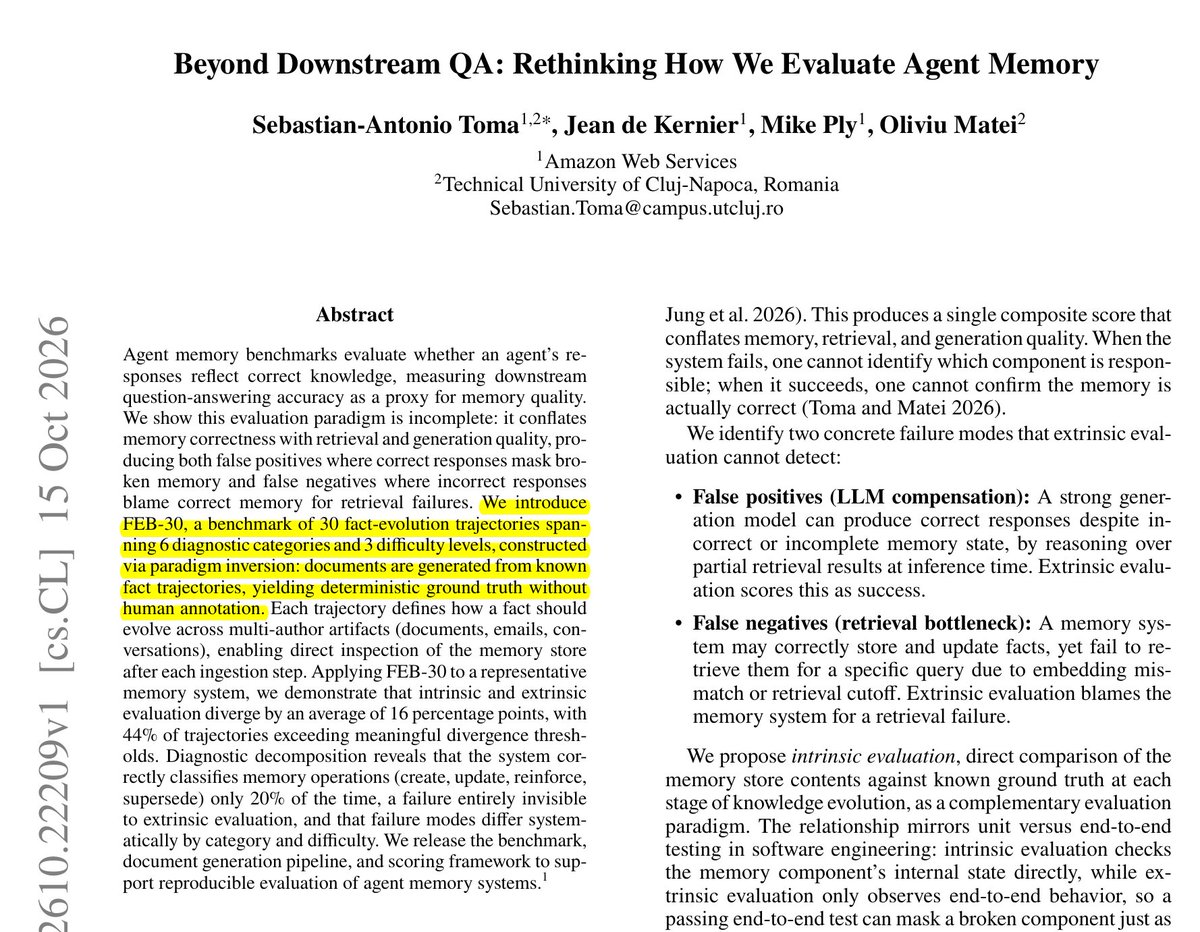
New Amazon paper shows that teams shipping agent memory should check what actually got stored, since QA scores alone did not reveal which pipeline stage was failing. Agent memory benchmarks grade the agent's answers, which mixes memory with retrieval and answer writing. A strong LLM can hide a broken memory store, and a retrieval miss can make a correct one look bad. They built FEB-30, 30 scripted fact histories turned into 147 documents, so the correct memory state is known after every document. On a memory system built like Mem0 and Hindsight, they compared the stored facts with that truth and with QA scores. The 2 scores differed by 16.8 points on average, and pass/fail verdicts disagreed on 21% of fact histories. The system picked the right memory action, like update or reinforce, only 20.1% of the time, which QA never showed. If you build agent memory, test the stored facts directly after each update, alongside end-to-end QA.
Cost per solved task is the number to watch here. METR's 2025 RCT found experienced open-source developers took 19% longer with early-2025 AI tools, even though they expected a speed-up. Has anyone timed these agent teams against a single strong agent?
New Cohere paper finds that a team of coding agents gets the most from extra agents when they only research and plan, and cheap models can do that job for a strong lead at far lower cost. A team of coding agents beats 1 agent working alone, but costs 3 to 7 times as much. More

@rohanpaul_ai For scale: CNBC (8 Oct) reported Anthropic put its run-rate revenue at $65B at the end of July, so a ~$48B starting stake is roughly nine months of revenue at that pace. Do you think the undisclosed baseline matters more than the 5%?
@rohanpaul_ai Memory is also the weakest spot in "A Definition of AGI" (Hendrycks et al., Oct 2025): GPT-4 and GPT-5 both scored 0% on long-term memory storage. Does FEB-30 show storage or update decisions failing more often across systems?
@teortaxesTex Economy tier is where the curve moves fastest: Epoch AI estimates the cost of reaching a given performance level has fallen ~47% per quarter since 2023, about 13× a year. How many months behind the frontier would you put V4.1 Flash?

Finnish Patriot 🇫�... @finpat17
334 Followers 2K Following #Gold #Silver #Crypto #BSV #Bitcoin #WLFI Digital Soldier 🐸 Handcash: $finpat17
Sy @Simeon_Cps
11K Followers 3K Following Building world-models for verified AI inference in London | former founder & CEO of SaferAI
Rob Wiblin @robertwiblin
53K Followers 888 Following Host of the 80,000 Hours Podcast. Exploring the inviolate sphere of ideas one interview at a time: https://t.co/2YMw00bkIQ
Daniel Kokotajlo @DKokotajlo
54K Followers 289 Following
Lennart Heim @ohlennart
17K Followers 776 Following managing the flop, and the labor it yields | @foundationOAI | prev @RANDcorporation @GovAIOrg @EpochAIResearch
Nathan Lambert @natolambert
106K Followers 954 Following Open model research, founder, director @trillium_labs. Prev. co-led Olmo at Ai2. Writes @interconnectsai, wrote https://t.co/alRXKINTwE
elvis @omarsar0
325K Followers 1K Following Building the frontier @dair_ai • Prev: Meta AI | PaperswithCode | Elastic | PhD

swyx @swyx
204K Followers 4K Following achieve ambition with intentionality, intensity, integrity & insanity. affiliations: - @smol_ai - @dxtipshq - @cognition - @aidotengineer - @latentspacepod
Teortaxes▶️ (Deep... @teortaxesTex
78K Followers 3K Following We're in a race. It's not USA vs China but humans and AGIs vs ape power centralization. @deepseek_ai stan #1, 2023–Deep Time «C’est la guerre.» ®1
Timothy B. Lee @binarybits
53K Followers 2K Following Reporting on AI and the future of the economy. CS masters degree from Princeton. Newsletter: https://t.co/MAwkvzSSr3 Podcast: https://t.co/aJSErfcE8Y
Jaime Sevilla @Jsevillamol
6K Followers 729 Following CEO of @EpochAIResearch. Trying to glimpse the future of AI.
Eli Lifland @eli_lifland
13K Followers 2K Following AI forecasting and governance @AI_Futures_. Co-author of AI 2040: Plan A, AI 2027, and the AI Futures Model. Also @aidigest_, @SamotsvetyF. Prev @oughtinc

Chubby♨️ @kimmonismus
152K Followers 3K Following Tech Analyst & Content Creator. Editor-in-Chief @getsuperintel - Community of 300k+ in total: 🔗 https://t.co/jHMmImmI5I //📧 [email protected]
Rohan Paul @rohanpaul_ai
160K Followers 7K Following Compiling in real-time, the race towards AGI. 🗞️ Get my daily AI analysis newsletter to your email 👉 https://t.co/6LBxO81tfN
Ajeya Cotra @ajeya_cotra
29K Followers 506 Following Helping the world prepare for powerful AI. Risk assessment @METR_evals (opinions my own). Blogs: Planned Obsolescence (AI), Good Bones (whatever's on my mind).

Peter Wildeford🇺�... @peterwildeford
38K Followers 410 Following Head of Policy @AIPolicyNetwork. Ohioan. World champion forecaster. Former data scientist. Protecting liberty and prosperity in the age of superintelligence.
Dean W. Ball @deanwball
76K Followers 2K Following head of strategic futures @openai | views mine, and mine alone
Gary Marcus @GaryMarcus
254K Followers 7K Following OG GenAI Skeptic; spoke at US Senate. Warned about hallucinations in 2001. Advocating world models & neurosymbolic AI ever since. Author, Marcus on AI & 6 books
Jack Clark @jackclarkSF
154K Followers 5K Following @AnthropicAI, writer @ Import AI. Past: @openai, @business @theregister. Neural nets, distributed systems, weird futures.
Séb Krier @sebkrier
31K Followers 8K Following 🪼 AGI jester | purveyor of machine funk, dimensional glider, deep ArXiv dweller, uncertain interstellar fugitive, views my own & not employer's 🛸


Lisan al Gaib @scaling01
61K Followers 1K Following lead them to paradise LisanBench: https://t.co/vorVk7Oks6 Impressum & Datenschutz: https://t.co/lFLgiu9cqs
Shakeel @ShakeelHashim
9K Followers 3K Following Editor + founder @ReadTransformer, covering AI policy. Prev: @TheEconomist, @Protocol, @finimize

Miles Brundage @Miles_Brundage
79K Followers 14K Following AI policy researcher, @lfschiavo wife guy, Executive Director of @AVERIorg, Substacker, fan of animals and sci-fi, views my own
Zvi Mowshowitz @TheZvi
45K Followers 323 Following Blogger primarily on AI and AI x-risk but also other things at Don't Worry About the Vase (SS/WP/LW), founding Balsa Research to fix policy.
Kevin Patrick Murphy @sirbayes
76K Followers 773 Following Research Scientist at Google DeepMind. Interested in Bayesian Machine Learning.
ℏεsam @Hesamation
91K Followers 869 Following AI Engineering / Research / Open Source / CrusaderBench: https://t.co/Ib0DkhWkEm
METR @METR_Evals
57K Followers 43 Following We work to scientifically measure whether and when AI systems might threaten catastrophic harm to society. Nonprofit.
Epoch AI @EpochAIResearch
77K Followers 0 Following Investigating the trajectory of AI for the benefit of society.
François Chollet @fchollet
748K Followers 831 Following Co-founder @ndea. Co-founder @arcprize. Creator of Keras and ARC-AGI. Author of 'Deep Learning with Python'.
Ethan Mollick @emollick
406K Followers 593 Following Professor @Wharton studying AI. New book, Co-Existence, coming October 20. Preorder here: https://t.co/hsDYf1xU9K Substack: https://t.co/UIBhxu4bgq
Andrew Curran @AndrewCurran_
109K Followers 20K Following 🏰 - I write about AI, mostly. Expect some strange sights.
Neel Nanda @NeelNanda5
49K Followers 126 Following Mechanistic Interpretability lead DeepMind. Formerly @AnthropicAI, independent. In this to reduce AI X-risk. Neural networks can be understood, let's go do it!
ARC Prize @arcprize
43K Followers 187 Following A North Star for open AGI. Co-founders: @fchollet @mikeknoop. President: @gregkamradt. We're hiring mission-driven builders: https://t.co/GswTSnyCoJYou might like


















