

-
Tweets31
-
Followers644
-
Following1
-
Likes33
Sharing my full Grand Rounds presentation at Lenox Hill Hospital on the scientific rationale, clinical applications, and future of therapeutic germline gene editing youtube.com/watch?v=G3zQyN…
Short preview of tonight’s interview discussing Origin Genomics’ first preclinical results
Origin Genomics reports initial preclinical data from OG-102, demonstrating prime-editing correction of a pathogenic APC mutation associated with familial adenomatous polyposis (FAP). We achieved 16.2% mutant-allele correction in primary patient-derived fibroblasts, with <1% local sequence disruption. This favorable local editing profile is encouraging as we move toward embryo studies assessing off-target activity and genomic integrity. Our goal is therapeutic germline gene editing: correcting inherited disease mutations at the earliest stages of human development.
Origin Genomics reports initial preclinical data from OG-101, demonstrating what we believe is the first reported prime-editing correction of a pathogenic BRCA1 mutation. We achieved >25% clean correction in a human breast cancer cell model, with 93–96% of corrected reads containing no additional local changes. Our goal is therapeutic germline gene editing: correcting inherited disease mutations at the earliest stages of human development. Next: WGS, iPSCs, and donated research embryos carrying the same mutation under our IRB-approved research program.
The case for therapeutic germline gene editing: correcting disease-causing mutations in human embryos to prevent inherited disease before it begins. At Origin Genomics, we’re taking a safety-first approach, building the evidence needed to understand whether this can be done safely and precisely.

No bird soars in a calm: therapeutic germline gene editing dlvr.it/TVjdGk
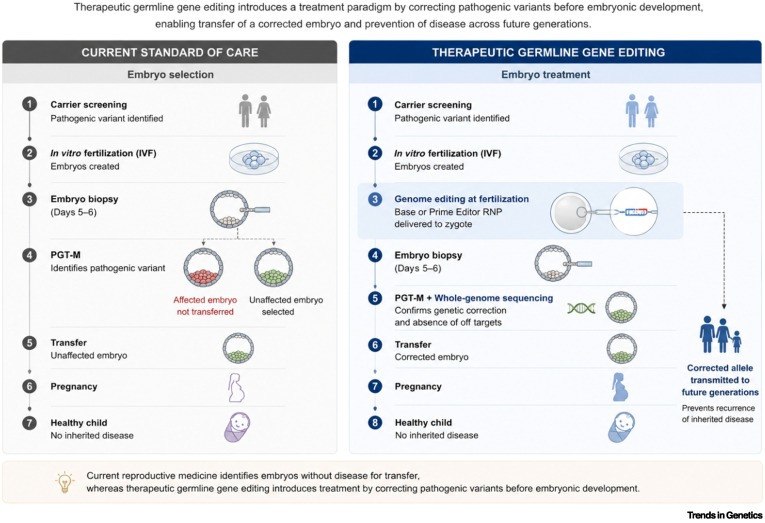
No bird soars in a calm: therapeutic germline gene editing dlvr.it/TVjdGk
A look inside Origin Genomics and our work to advance therapeutic germline gene editing, from NPR. npr.org/2026/09/29/nx-…
Origin Genomics works on correcting disease-causing mutations in early embryos, in the United States, under independent IRB oversight. Our research priorities are editing fidelity, reducing mosaicism, and off target analysis in early embryos, with a focus on diseases that have no treatments today. Source: launch release, 19 March 2026. businesswire.com/news/home/2026…
IRB approval secured. Origin Genomics begins human embryo gene editing experiments in the NYC lab.

Great line here from Cathy Tie in the Guardian about how germline gene correction, limited to correcting terminal or debilitating conditions, upholds the sanctity of human life.

1. Our IRB-approved research is intended to study the safety of germline gene editors and help create safe germline gene therapy frameworks in the future. 2. 95% of monogenic diseases have no FDA-approved cures, there are millions of real families suffering from passing down
Interesting proof-of-concept for multiplex base editing in embryos. That said, we were surprised by the lack of optimization and benchmarking. The study does not explore guide stoichiometry, delivery parameters, RNA stabilization strategies, or next-generation ABE variants designed to improve editing precision and reduce bystander activity. We were also surprised by the comparison against Cas9 rather than against the current generation of adenine base editors. Finally, editing outcomes in MII-stage embryos cannot always be inferred from observations in HEK293 or hESC systems, making developmental context an important variable to consider. At Origin Genomics, we believe these questions are the real frontier. We're building experimental systems to systematically study how editor architecture, delivery, guide design, and developmental context influence editing outcomes in human embryos. The paper demonstrates feasibility. The more interesting question is how much further efficiency and precision can be pushed with systematic optimization.

1. Our IRB-approved research is intended to study the safety of germline gene editors and help create safe germline gene therapy frameworks in the future. 2. 95% of monogenic diseases have no FDA-approved cures, there are millions of real families suffering from passing down genetic diseases to their children. 3. Parents constantly make decisions for their children's health, that is the standard in bioethics. All medication, like gene therapies (e.g. Baby KJ's case) that are given to newborns or infants are consented under this framework. 4. Safe germline gene correction offers the possibility of preventing the passing down of severe genetic diseases generation after generation, that's what makes it highly effective. Thus, more research should be done on its safety and efficacy as we charter into this medical frontier. #bioethics

@OriginGenomics How can germline gene editing be considered “responsible” when it carries the risk of unintended off-target effects that may impact future generations in unknown ways? Shouldn’t prudence come first, especially when the consequences are irreversible and affect individuals who

Genetic surgery to correct damaged embryos is something that could be life-changing (and life-creating) for some parents struggling to have children. The technology is here to do this. It's time to have the hard conversations on how to do this safely and ethically. I encourage people to listen to the debate Cathy mentions here, see thehastingscenter.org/news/should-we…
For the past year, I have been the subject of multiple biotech media takedowns and hit pieces. I kept my composure through all of it. But recently, a different line was crossed when I was mentioned in the same article as a keynote speaker at the world’s largest gene and cell
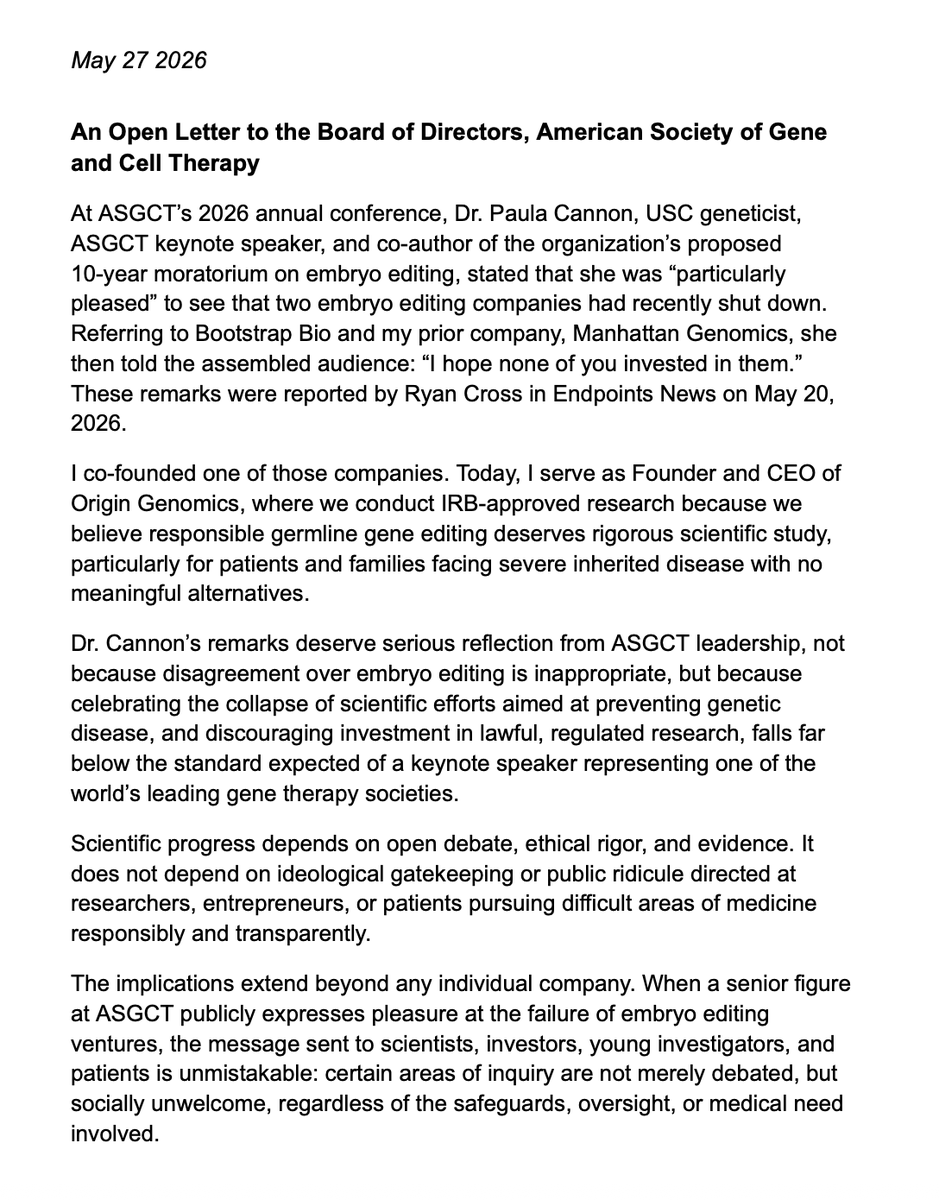

For the past year, I have been the subject of multiple biotech media takedowns and hit pieces. I kept my composure through all of it. But recently, a different line was crossed when I was mentioned in the same article as a keynote speaker at the world’s largest gene and cell therapy conference (@ASGCTherapy), who proceeded to speak and act in a way that is not only unprofessional towards me, but compromising to the American public. Her words and actions deserve serious scrutiny and accountability. Not for me, or the scientists and entrepreneurs in this field, but for the patients left with no options for their genetic diseases. This is why I penned an open letter to the Board of Directors at ASGCT.
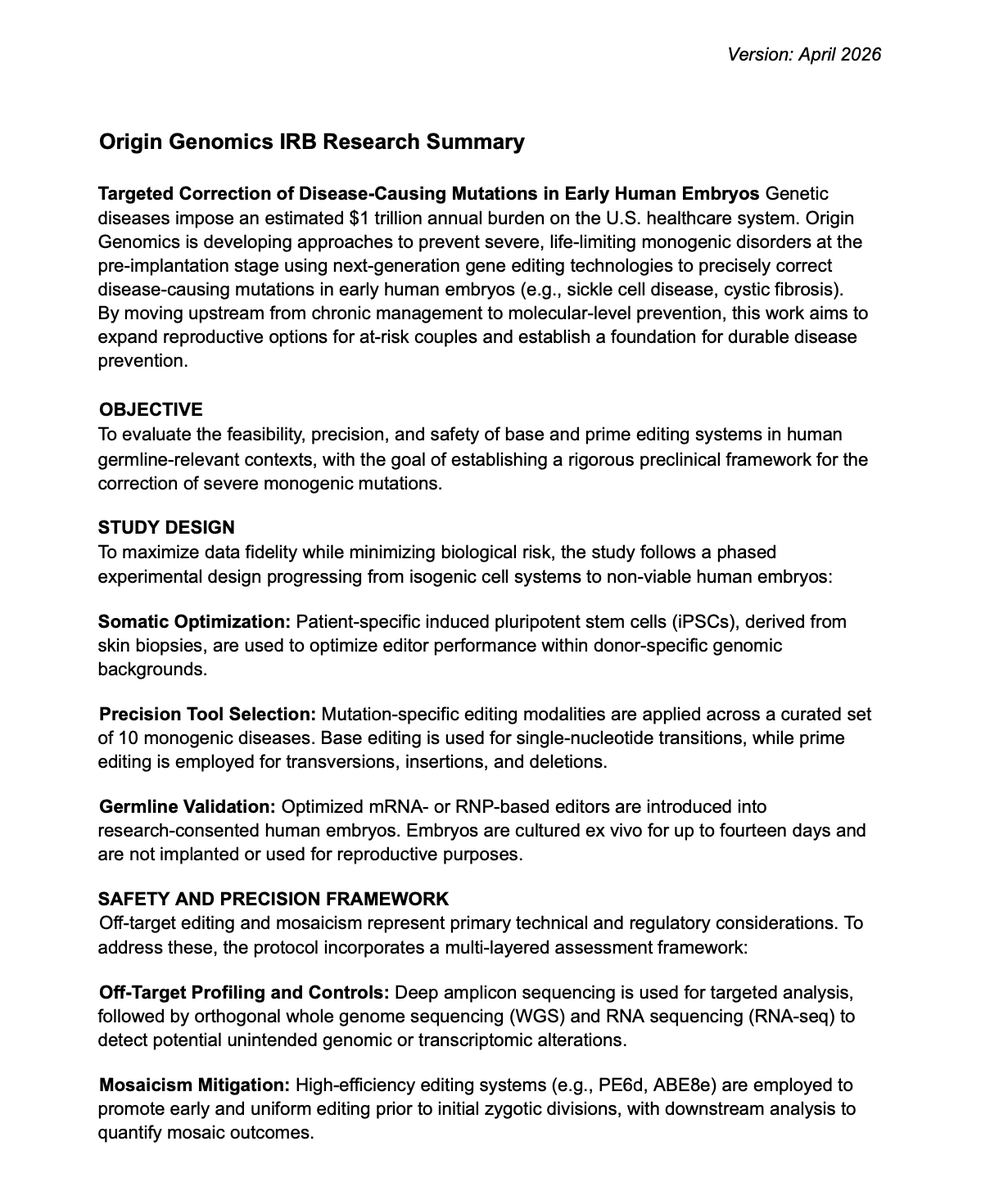
We believe frontier biotechnologies like germline gene editing must be developed transparently and responsibly. That’s why Origin Genomics publicly shared our IRB summary, which we believe is a first for this field. We hope more companies follow. Long-term public and regulatory trust will not come from secrecy, but from rigor, transparency, and accountability.
Sharing for the first time, our research plan: Human embryonic gene editing to correct disease-causing mutations and prevent heritable disease. All research conducted with IRB oversight in the United States. Transparency is core to how we operate at @OriginGenomics.

Big thank you to Nicole and Asaf for courageously sharing their experiences with IVF and genetic disease at the Annual Hastings Center debate, bringing a much-needed human perspective to the conversation on embryo gene editing.
@CathyTie Thank you Cathy for fighting for the people and patients this affects! Also a big thanks to the couple who spoke last night. To be in the thick of 3 years of IVF and stand in front of a bunch of people who happily deny you the care you desire, takes so much strength
Full debate can be found here: youtube.com/watch?v=kQxd39…
In germline gene correction, risks don’t just affect one person, they can carry forward across generations. But the same is true for benefits. Preventing a serious genetic disease once could mean no one in that family ever has to face it again. Our founder, @CathyTie, debates Glenn Cohen, Deputy Dean of Harvard Law School at the Annual Daniel Callahan Program hosted by the Hastings Center.

VIDEO: The Embryo Frontier: Editing Human Life. The full debate on human heritable genome editing between @CathyTie @OriginGenomics and Harvard bioethicist Glenn Cohen @hastingscenter youtu.be/-Gycnn8QkVo?si… via @YouTube

Sharing for the first time, our research plan: Human embryonic gene editing to correct disease-causing mutations and prevent heritable disease. All research conducted with IRB oversight in the United States. Transparency is core to how we operate at @OriginGenomics.

99 @1999JS32
65 Followers 4K Following
HDP @HDPbilly
5K Followers 7K Following longsword farming tailoring nanoscience ~=~ Mixed Radix Enjoyer and topological computing maximalist ~=~ machine interface @hyphaeic
Amir @amirhaqiqati
125 Followers 6K Following آیَتُلّا هامِناِی ایزْ دِدْ Ayatolla /Hâmenay/ is DEAD PhDing in CompSci Anti-Gnostic; Biblicist; Bibliophile; Abolitionist
Aaron Blotnick @AaronBlotnick
1K Followers 5K Following I drink coffee and I learn things ☕️ Bio-Economy, AI, and Planetary Adaptation @synbiobeta / @bitsinbio


Ojas Brahme @ojasbrahme
60 Followers 842 Following Student and Researcher (trying not to slopcode my way through life)
ARΞS @Afrectz
3K Followers 7K Following Trends before they go mainstream AI & Robotics - @AreslabsAI , ex.Researcher - @ABCDELabs.
BunnBunn @cole24186
44 Followers 503 Following


Screenshots and Coffe... @WhackyPaeds
5 Followers 116 Following Deranged Clinician scientists planning world domination one screenshot at a time. No copyright infringement intended. :P
Jared Fudge @fudge_jared
799 Followers 3K Following Professional plant-science enthusiast. Formerly an editor at @NatureBiotech @NaturePortfolio and @CurrentBiology @CellPress. Opinions are own.

Adam Eckardt @AdamBuildsBio
8 Followers 272 Following


Guilherme Gatti, Ms, ... @guigatti04
125 Followers 268 Following RNA biologist with specialized training in neuroscience and computational biology. Always appreciative of a COLD black beer after a day in the lab.
taga ilog @unstableisotop3
11 Followers 1K Following
Brian M. Schilder @BMSchilder
692 Followers 3K Following 🧠 Brains, 🧬 genes, and 👾 learning machines! PhD Candidate UK Dementia Research Institute Faculty of Medicine Imperial College London ⚕💻🧪🦠🦍 🦇
Gagandeep Singh @Gagande75920215
11 Followers 1K Following
Aaron Edwards @aedwards02
2K Followers 3K Following Building noise-cancelling headphones for cell therapies @KiraGenBio starting with glioblastoma @HarvardHBS • @BeamTx • @BluebirdBio
glwlbrgr @cluelessnphx
478 Followers 2K Following Current events, Biotech, $PRME 🧬, Phoenix metro, Oregon Duck 🦆'76, satire, people watcher, DBacks, Mariners
Alfonso Martinez Aria... @AMartinezArias
10K Followers 920 Following Born and bred in Madrid, brewed in Chicago and Cambridge. Curious about how cells build embryos #NotIntheGenes #InNumbersWeTrust
Joseph Quintilian @JoeQTrader
2K Followers 4K Following Partner Distributed Capital | Co Founder Ajna @ajnafi | Ex MakerDao


Flagnarok @flagnarok
0 Followers 5K Following

Sensacional 💜 @kwakuarnold_f
155 Followers 1K Following Let me in on the gist🤞. ||politics||😏 I might as well require the philosophical intellects of Plato and his peers🙈||entertainment 😂|| I retweet
c.c deville @wild_pursuit
292 Followers 1K Following

Justin Echternach @JustinEchterna9
2K Followers 4K Following Viam inveniam aut faciam - Founding engineer, Consciousness, AI ... Building Synthesis Lab - Beta - https://t.co/eZBW5BK04k X - @synthlabcom

Stefan Cristian Stane... @scstanel
482 Followers 740 Following Respiratory/Interstitial Lung Diseases (ILD) physician with various other interests. Medical communication, common sense and personal views here & @ILDinfo
sath770 @sath770
25 Followers 235 Following

Ben Weisburd @benweisburd
343 Followers 1K Following Computational scientist @ the Broad Institute / TGG

JY @oceaninoursouls
0 Followers 75 Following

Leo @leojnjian
194 Followers 2K Following
Christine @Ethereal8
88 Followers 322 Following
Surjyendu Ray @surjray
93 Followers 3K Following Data Scientist Lead @LexisNexis Risk, AI enthusiast, astronomy/cosmology nerd, Genomics and computational Biology in a past life! Building towards AGI and ASI!

Davis Washington @Digitalalchemy0
4K Followers 7K Following Multipotentialite/Futurist. Senior Analyst at J.F. Bicking & Co. . https://t.co/7ixlKD09F5
Paul Knoepfler @pknoepfler
20K Followers 5K Following Prof @UCDAVIS peds cancer & stem cells. Blog https://t.co/oXW4PiaYAl Bsky https://t.co/xx09HxJXgF STAT https://t.co/6RAkEo8zVn
For @2a4btn
10 Followers 377 Following
You might like


















