

Ionic Wealth @ionicwealth
Co-founders in your journey of Wealth creation SEBI Registration links: https://t.co/QytdRihYEj https://t.co/eqn419vSo5 ionic.in Mumbai Joined March 2024-
Tweets1K
-
Followers9K
-
Following7
-
Likes529
SIFs have completed one year, and the industry has grown nearly 19-fold since its first official monthly data in October 2025. According to AMFI data, SIF assets under management (AUM) stood at ₹38,267 crore in September 2026, up from ₹2,010 crore in October 2025. Hybrid SIFs remain the largest category, accounting for 63% of industry assets. But other categories are also coming up. For context, hybrid SIFs had 75% share in March, suggesting other categories are gaining ground. Curious to see how SIFs have stacked up against mutual funds over the past year? We’ve compared their performance across MF categories in our latest Substack. Substack: ionicwealth.substack.com/p/sifs-are-a-y…

AI’s next bottleneck may not be computing power, but the energy and infrastructure needed to sustain it. As AI workloads grow and data centre racks become denser, power availability and heat management are becoming increasingly critical. This is driving demand for advanced cooling systems, power equipment and more efficient ways to manage energy. The result? Power and cooling are emerging as key parts of the AI infrastructure investment story, creating opportunities for equipment providers while bringing new capacity constraints into focus. So, what is driving this demand? Which technologies are helping data centres manage rising power and cooling requirements? And which companies stand to benefit? In this edition of #TuesdayTechTrivia, we continue our AI data centre series by exploring AI’s energy equation - from power requirements and cooling technologies to infrastructure bottlenecks and the companies positioned to benefit. Read More: ionic.in/blogs/global-i…

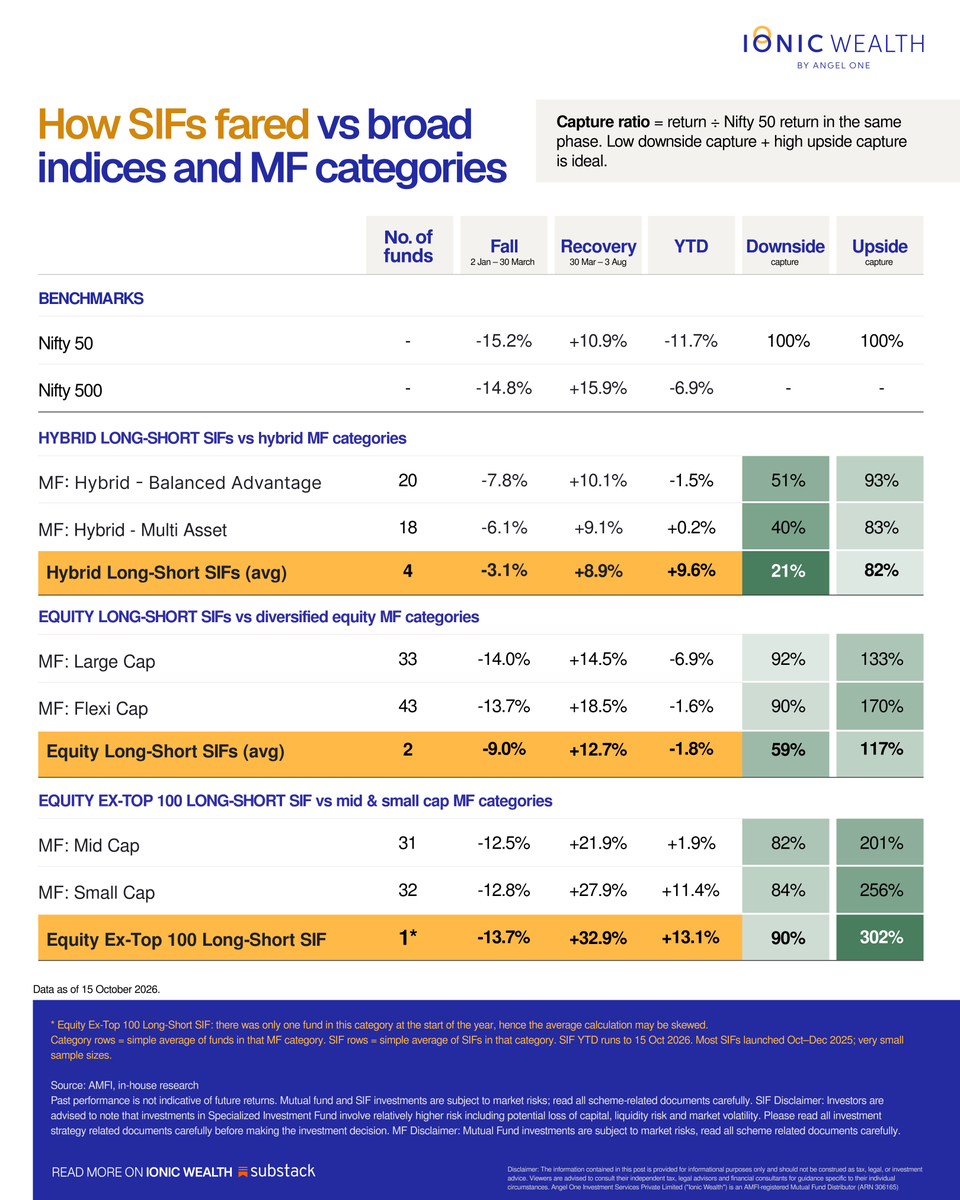
As SIFs complete their first year, we look at how they have performed against mutual funds in similar categories. We compared returns across three periods: 1) The market downturn between 2 January and 30 March, when the Nifty 50 fell 15.2%; 2) The recovery between 30 March and 3 August, when it rose 10.9%; and 3) Year-to-date returns, as of October 15. The numbers reveal an interesting pattern. SIFs have generally held up better than mutual funds during the downturn, but lagged them during the recovery. Here’s how the two stack up. (See table below) Disclaimer: Past performance is not indicative of future returns. Read: ionicwealth.substack.com/p/sifs-are-a-y…
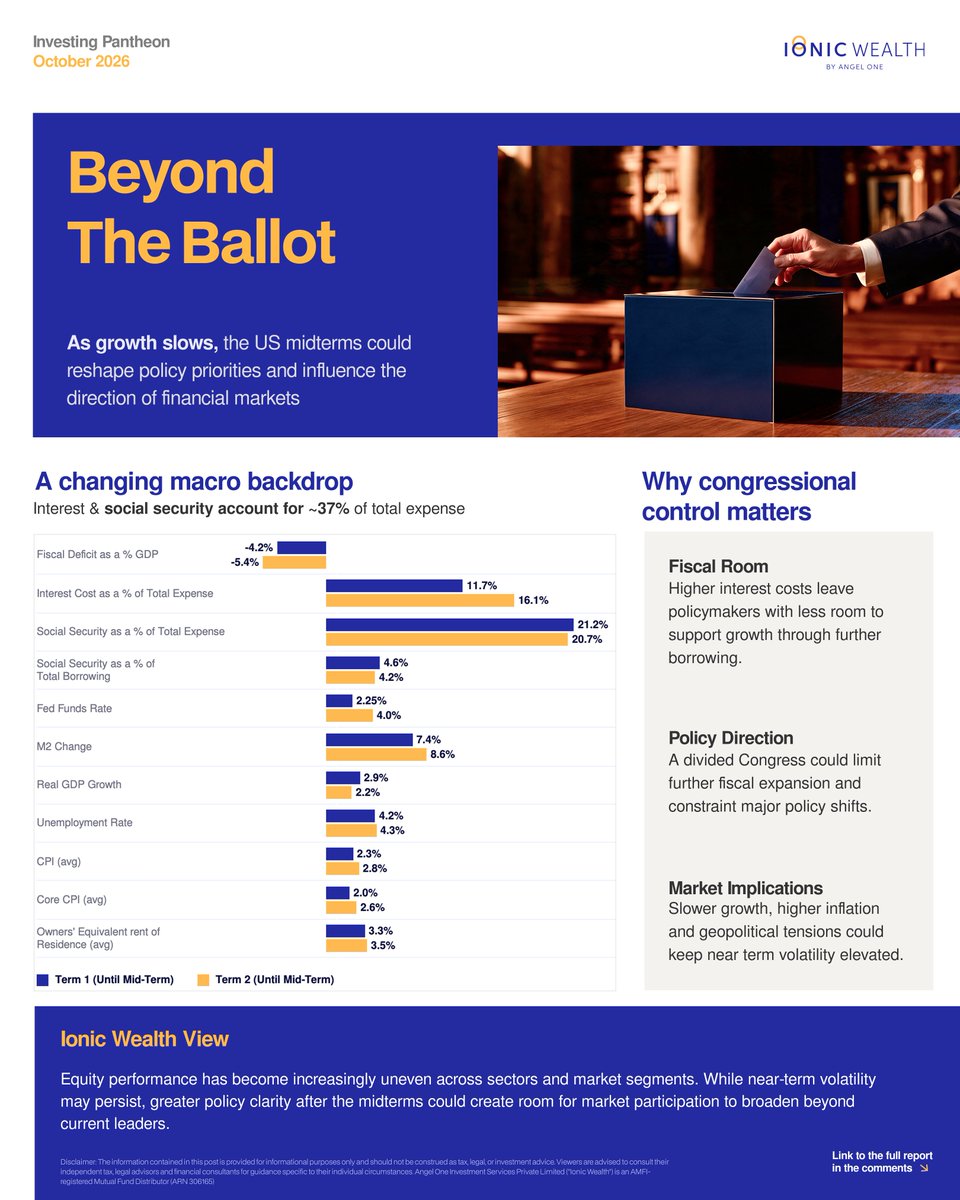
What happens if the people making economic policy no longer have the votes to push it through? That is the question facing markets as the US heads into its midterm elections on November 3. With economic growth slower in President Trump’s second term than in the first, the direction of policy becomes an important part of the outlook. With control of Congress at stake, the outcome could influence how easily the government moves forward with spending plans and economic policies over the next two years. A divided Congress could change the direction of fiscal policy, with potential implications for inflation, interest rates and equity market performance. What’s more the effects may not be uniform, with different sectors responding differently to evolving policy priorities and market expectations. For investors, the focus goes beyond who wins or loses. It is about understanding how the interplay between economic growth, political control and policy direction could shape the market outlook. To understand how the evolving US economic and policy landscape could influence global markets, read the Investing Pantheon October 2026 report. Read More: ionic.in/blogs/global-i…
Wealth management is not just a growing industry. It’s also evolving rapidly. Over the past quarter, we’ve seen how AI is reshaping industries, improving how we live and work while making some activities redundant. At Ionic Wealth, we believe progress is about more than headline numbers. It’s also about staying ahead of change and helping shape the future of wealth management. In that regard, the past three months have been action-oriented. We have reported strong numbers, and on top of that, we’ve built strong pillars for what's ahead, including: 1) Launch of Ionic Wealth AI - institutional-grade investment thinking via wealth intelligence in our app. 2) Making investment opportunities more accessible - through digital accreditation and for global access via GIFT City. 3) We are also looking forward to what’s ahead, with tailwinds from the new regulatory framework around portfolio management. As these changes take shape, our focus remains on combining technology, investment expertise and evolving market opportunities to help investors make better-informed decisions.

Read the full post on the Ionic Wealth Substack. A new post every Saturday. Here: ionicwealth.substack.com/p/is-the-portf…
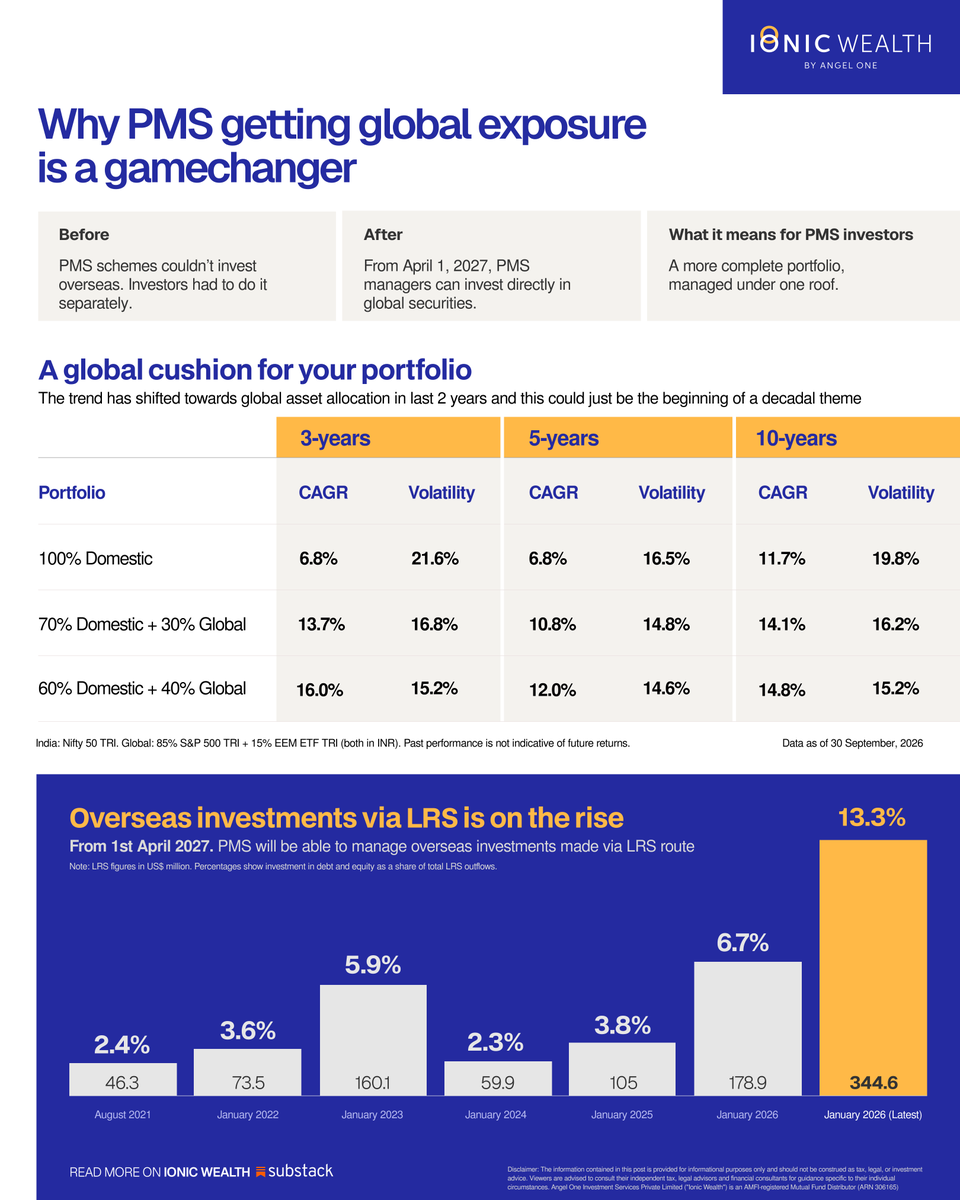
The market regulator has allowed global allocation in PMS schemes. Starting April 1, 2027, PMS managers can include global securities in investors’ portfolios. But why does it matter? Research shows that, over time, a traditional 60:40 portfolio of domestic equities and debt underperforms portfolios that allocate part of their investments to global securities. Indian investors understood this and increased their allocation to global securities. But PMS managers could not invest outside India. Investors who wanted global exposure had to open a foreign brokerage account and pick foreign stocks themselves or buy an overseas fund. PMS remained limited to domestic allocation. For the PMS industry, this is similar to the ‘Mark 50’ moment. Remember Mark I, the first Iron Man suit, built inside a cave and armed with little more than a flamethrower? It did the job, but Tony Stark kept updating the suit. By Mark 50, he had added nanotechnology, arguably the biggest upgrade to the Iron Man suit. The PMS industry has also evolved, but allowing global securities could be the change that makes the PMS structure a game-changer.
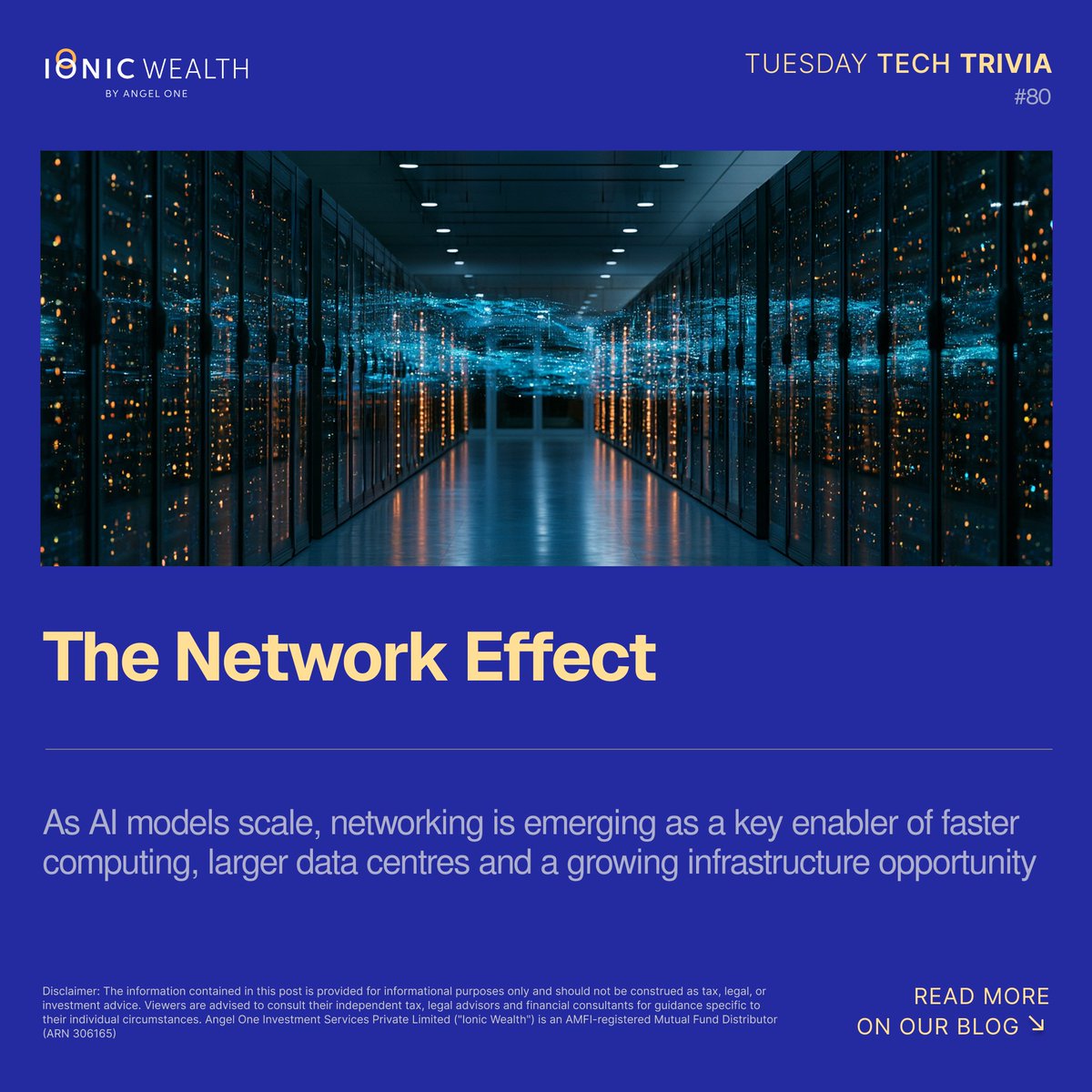
AI data centres may be built around powerful GPUs, but networking determines how efficiently they work together. As AI workloads grow, the need to move massive amounts of data between GPUs is driving demand for faster switches, higher-bandwidth connections and advanced optical technologies. At the same time, the shift towards larger AI clusters is creating new opportunities across the networking ecosystem, from Ethernet and InfiniBand to optical interconnects. The result? Networking is becoming an increasingly important part of the AI infrastructure investment story. So, what is driving the surge in AI networking? How are rising speeds reshaping the demand for copper and optical connections? And which technologies and companies stand to benefit the most? In this edition of #TuesdayTechTrivia, we continue our AI data centre series by exploring the networking layer of the stack - from switches, NICs and cables to bandwidth, emerging technologies and the competitive landscape. Read More: ionic.in/blogs/global-i…
Read the full AssetX report: ionic.in/blogs/wealth-s…
A portfolio can stay invested without staying static. That's especially true with factors, because not all stocks respond to the market in the same way, and relative performance can shift even when the broader backdrop stays constructive. Factor analysis helps us see why, by looking at characteristics like Value, Momentum and Low Volatility, and where relative strength is building. This month, the signals point to continued weakness in value and strengthening positions in momentum and low volatility. We've adjusted our tactical allocation accordingly: out of Value, and into a 50:50 split between Momentum and Low Volatility. The aim isn't to favour one factor indefinitely. It's to stay responsive. Momentum gives exposure to areas with stronger relative performance, while Low Volatility keeps the allocation balanced. As market leadership evolves, so does the way we position around it. Explore the factors shaping our latest allocation in the AssetX October 2026 Report, see link in comments.


A 10-year lock-in may look harmless today. Then life changes. A job loss. A house you want to buy. An unexpected expense. Suddenly, access to your own money matters a lot. #SrikanthSubramanian, Co-founder & CEO of @ionicwealth, speaks with Anupam Gupta @b50 on Paisa Vaisa. #Investing #Liquidity #PaisaVaisa
Your wealth is not a collection of accounts. It is the result of decades of decisions, trade-offs, ambitions, risks and changing priorities. And just as your life evolves, the right approach to your wealth should evolve with it. The future of wealth management won’t be defined by who can manage the most assets. It will be defined by who understands the person behind them. Because the goal was never simply to manage what you built. It was to help you make better decisions about what comes next. Download Ionic Wealth AI and experience intelligence built around your wealth, not just your portfolio: ionicapp.onelink.me/O8Xg/cjxtwdfq
GPUs may get the spotlight in AI, but memory is what keeps them running. As AI data centres scale, demand for DRAM, NAND and HBM is accelerating. HBM is taking up an increasing share of wafer capacity, putting pressure on memory supply for everyday devices, while new fabs take years to come online. The result? Memory is emerging as one of the biggest potential bottlenecks in the AI infrastructure buildout. So, what exactly is driving this memory crunch? How is DRAM evolving into HBM? And how long could supply remain tight? In this edition of #TuesdayTechTrivia, we continue our AI data centre series by unpacking the memory layer of the stack - from DRAM, NAND and HDDs to pricing, margins, capacity and market share. Read More: ionic.in/blogs/global-i…

Technology can process information at extraordinary speed. But when it comes to your wealth, information alone isn’t enough. Investing still needs a human layer, one that can challenge the obvious, question the assumptions and connect the dots across markets. That’s the philosophy behind Ionic’s Investment Think Tank, our human capital layer that studies markets, debates opportunities and identifies risks every day. Ionic Wealth AI brings this idea together with the scale of technology, combining institutional investment expertise with the context of your financial life. Because smarter technology isn’t about replacing judgement, it’s about giving judgement greater context. Download the Ionic Wealth app and put wealth intelligence to work: apps.apple.com/in/app/ionic-w…
Disclaimer: This Chartbook is for informational purposes only and should not be considered investment advice or a recommendation. Readers should conduct their own due diligence and consult relevant advisors before making any investment decisions.

India’s wealth landscape is entering a new phase. Family offices, alternative assets, succession planning and new-age sectors are becoming important themes as wealth moves from one generation to the next. The future of family wealth will be shaped by how it is structured and managed.
India’s billionaires control nearly $1 trillion of wealth. But creating wealth is only the first chapter. The next challenge is preserving, managing and transferring it across generations. This month’s #Chartbook explores how family offices are institutionalizing, and how they are shaping the future of family wealth.




WarriorMonk @WarriorMonk_10
26 Followers 403 Following
James @Georgia08386115
320 Followers 1K Following


Chhoti Kumar @ChhotiK22228828
230 Followers 3K Following

Indian CA @taha786110
493 Followers 5K Following An Indian Chartered accountant, here to motivate you and make your life easier 🥹🌞✨ I am not a SEBI registered advisor. Founder Altaha Screener

Kirtiraj Jain ✨ @mrkirthi_24
219 Followers 941 Following applied ai https://t.co/ouN6oRVVaQ prev: @ionicwealth https://t.co/qUKKhPYiGt | startup nerd ✨
SHIKHAR @shikharshreyas
4 Followers 170 Following
. @funnyone0000
32 Followers 521 Following
Gursharan Singh Sethi @Gurshar17951972
41 Followers 816 Following

guru praveen @suntzubuffet
14 Followers 282 Following
Uttkarsh Ajmera @AjmeraUttkarsh
11 Followers 80 Following
heyy @Uttkars39953762
3 Followers 29 Following
Rohit Onkar @RohitOnkar
277 Followers 176 Following Digital Marketing Leader. A firm believer of Jesus. I believe love can conquer everything.
Rajat @Rajat46840123
81 Followers 5K Following
Sagarkumar G Patel @AashiWealth
41 Followers 200 Following MFD -- (ARN - 304647). I Help People Align Their Investments With Their Real Financial Goals. Passionate About Demystifying Personal Finance and Investing.
Gopal Krishan Mittal @gkmittal07
268 Followers 454 Following आज फिर दिल ने एक तमन्ना की, आज फिर दिल को हमने समझाया.....
Utsav Gogirwar @utsavgogirwar
104 Followers 1K Following A calm headed, likes to explore and visit new places..
kkeval @quest4absolute
49 Followers 308 Following
woodpecker @s132134
23 Followers 148 Following
Surya jayasree Adigar... @SuryaAdiga9657
0 Followers 8 Following
Manjunatha K B @ManjunathaKB20
150 Followers 952 Following
Peyton Douglas @_peytonDAI
42 Followers 144 Following


Aadi @AadiJagdale23
3 Followers 52 Following
Tradervickyofficial @Vignesh_1082
120 Followers 331 Following I'm a trader who has 10 years of experience || NISM certified Equity derivatives || Currency derivatives || Commodity derivatives
Mari @ma_ri1
303 Followers 3K Following Maverick..Rebel....Iconoclast...Constructive Nonconformist.. Futurist...No-nonsense...Frank & forthright...Simple!
Sushant Thakur @Sushant17192603
9 Followers 136 Following
Nirmal Veerappan @Nirmal_veera89
86 Followers 2K Following
Nishant Thakker @nishant_thakker
171 Followers 1K Following Retweet endorsement of thoughts but not always. Opinions are mine and not of my employer.
Rohit Kasture @Rohit_kasture
108 Followers 443 Following Solutions Engineer - VMware Helping customers in their Cloud adoption journey!
Pratham Sawhney @PrathamSa8933
56 Followers 730 Following
Ajay Biswari @AjayBiswari9
808 Followers 1K Following Helping Families Compound Wealth📈 MF, SIF, Unlisted Shares & Investments | NISM Certified | AMFI Reg Personal Finance | 18+ Yrs Research & Advisory DM Open
dikshant @dikshantchauh16
47 Followers 363 Following
Abhishek Mittal @MitsAbhi
26 Followers 259 Following
Hemal Kapasi @hemal_kapasi
34 Followers 197 Following
Sumit @Sumit49050175
15 Followers 177 Following
Prashant Singhvi @PSinghvi78
16 Followers 31 Following
Sanjay Gupta @SanjayG82803087
22 Followers 418 Following
B (Previously A) @Endian_by_heart
308 Followers 836 Following Engineer, Like to Read/Write, Sarcastic, Hate Hypocrisy.
Shaleen Patni @Devils_CA
145 Followers 1K Following CA, Law Graduate, Investor, Personal Finance Consultant, Travel & CC Enthusiast… Dealt with the Devil and lived to tell!
Anand Rathi @AnandRa18225371
13 Followers 115 Following
Abhi @Abhi93857418525
6 Followers 99 Following
Pratik Shah @prat26
287 Followers 2K Following Chemical Engineer||BITSian||ONGCian||Explorer||Foodie||Investor||Learner for life||
Dinesh Thakkar @DineshThakkar
5K Followers 29 Following Chairman and MD - Angel One; with a vision of making Angel One the largest retail broking house in the country. Also, super-car enthusiast!
Amit Kumar Sharma @amit_aks
98 Followers 10 Following CTO @ Ionic Wealth | ex-(Zoomcar | Teabox) | IIT Delhi
Jaspreet Bindra : Hom... @j_bindra
12K Followers 1K Following Author, Educator, Speaker, Entrepreneur, Learn-it-aller, more at https://t.co/tHKIHE1vsR and https://t.co/YetnJP7Z7P
Harsh Gupta Madhusuda... @harshmadhusudan
121K Followers 5K Following Long India. New India. Dharmatva.
Ankita Pathak @ankitapathak_
9K Followers 587 Following Global Equities at @ionicwealth | MBA, Forté fellow @insead |Commonwealth scholar @warwickuni |LSR| ex @dspmf, @nuvama_wealth

Trends for United States
You might like


















