Patrick Collison @patrickc
@Stripe CEO, @ArcInstitute cofounder. patrickcollison.com [email protected] Joined April 2007-
Tweets10K
-
Followers1.8M
-
Following30
-
Likes28K
These days, I'm struck by how the dominant mood on both sides of the Atlantic toward the other is a kind of pity. Europe frets about the US's supposed slide into autocracy; the US about Europe's pusillanimity and immiseration.
Excellent report on the NSF from Matt Faherty: newscience.org/nsf/. I wish there were more deep investigations and assessments like this of government agencies in the US, the EU, and elsewhere.

potentially a hot take but @Stablecoin is still underrated, such a good product and a world class team that just keeps shipping
I very highly recommend visiting the UK's great cathedrals, e.g. Lincoln and Durham. I did so earlier this year and find myself reminiscing about them quite frequently. Some of the most beautiful buildings in the world.
Today is probably a good time to check in on things with @privy_io, which became part of @stripe just over a year ago. Our acquisition was predicated on three factors: stablecoin growth, self-custody as a key enabler of broader global coverage, and rapidly increasing demand for programmable financial infrastructure. As we said at the time, "money has to reside somewhere, and Privy builds the world's best programmable vaults." Since then, the Privy team has executed exceptionally well: assets in Privy wallets have grown ~25x, monthly active developers are up ~3x, revenue is up ~9x, and Privy now facilitates nearly $25B of monthly transaction volume. @tryramp, @Deel, @Klarna, @felixpago, @HyperliquidX, and thousands of other businesses are building embedded banking functionality on Privy. At Stripe, we're deeply integrating Privy into Treasury, @Link, and Connect. In each case, it's accelerating our global expansion, and enabling us to build better functionality faster. (Coming soon: @Link balances.) We're also seeing that Privy's wallet infrastructure is the ideal substrate for agents to transact and earn -- live today with @merit_systems, @orthogonal_sh, @Nevermined_ai, @prlnet, and more. Developers prefer programmable financial infrastructure, but agents need it. We expect that the agentic economy will continue to grow extremely quickly. The Privy team has maintained remarkable product velocity, with major launches this year including deposit addresses, earning on Privy balances, digital asset accounts, custodial wallets, and Stripe's own stablecoin cards. It's also been neat to see how Privy has been accelerated by Stripe, with better onramps, @stablecoin payment rails and licenses, Stripe's fiat capabilities and issuing stack, and integration with @Tempo. Together, we're building one API for holding stablecoin balances and earning yield, moving money in and out of fiat, and orchestrating spend with cards. We still have a lot of work to do, not least in integrating everything across Privy, Bridge, and the rest of Stripe -- there's been so much feature and functionality expansion that we haven't yet had much time to reconcile everything. Overall, though, I'm very happy with how things are going, and excited by where these capabilities are headed. If you're interested in working on the future of stablecoins, agentic payments, and crypto's deployment in the real world, you should get in touch with @sternhenri (now leading all of @stripeCrypto) or others on the team.
Stablecoin-backed cards make make global balances instantly usable at 100M+ businesses. We're looking forward to working with @Plasma to advance the space.

We're bringing together Stripe's fiat and crypto infrastructure to make it easier for businesses to build stablecoin-backed cards that work across currencies and markets. More on what we're building with @Plasma, x.com/i/article/2110…

The future of banking will run on stablecoins. On Plasma, in partnership with @StripeCrypto.
We're bringing together Stripe's fiat and crypto infrastructure to make it easier for businesses to build stablecoin-backed cards that work across currencies and markets. More on what we're building with @Plasma, x.com/i/article/2110…

My full fireside conversation with @patrickc at the Science: A New Golden Age Summit. We discussed building new institutions for discovery, accelerating scientific progress, and how America can move faster on the hardest scientific challenges.

If you’re using stablecoins for real-world use cases, it’ll soon be unthinkable that they aren’t private. Too much of crypto relies on pseudonymity instead of privacy, especially in the age of AI as it becomes easier to track and correlate transactions onchain. Tempo has been working on Tempo Zones as a scalable, technically nuanced, and highly practical solution to onchain privacy. And the first Tempo Zone is now live with Deel, adding privacy to their global contractor payouts. We all want real-world flows to scale onchain, and privacy is a clear prerequisite to that. The Tempo team has worked hard to craft a practical solution and if you’re interested in learning more, please reach out to the team!
Privacy is live on Tempo. Tempo Zones let enterprises keep customer stablecoin balances and payments private, with built-in compliance controls and access to global liquidity. @deel is the first customer with Zones live in production.
New from @stripepress: the definitive guide to sales. I notice that startups today are scaling sales faster than ever, making it more valuable to get structures and incentives right from the outset.
Out now! Built to Grow: A Handbook for High-Performance Sales Teams, by Stephanie Friedman: press.stripe.com/built-to-grow I love all of the books in our catalogue, but I particularly love the turpentine collection: High Growth Handbook, An Elegant Puzzle, Scaling People, and now,


I’m very biased, but the new @WorksInProgMag is IMO a masterpiece in both design and content. worksinprogress.co/print/

The @WorksInProgMag team has outdone themselves this time, I didn’t know that was possible We got flaps and everything! What a stunning piece of art!


@destraynor Absolutely. #Justice for @destraynor.
Brothers Karamazov was Einstein’s favorite novel, a verdict he shared with Freud, Hillary Clinton, and Murakami. Dostoyevsky was Pope Francis’s favorite author. Indeed, he approvingly quoted Elder Zosima; perhaps an interesting case of art molding life. At the risk of betraying my relative shallowness and inferiority, I confess that I did not love it. Written in the shadow of the death of Dostoyevsky’s son (also Alyosha), and, more broadly, after a life of repeated tragedy, Karamazov attempts most of all to address the problem of evil in Christianity. Ivan presents a trenchant argument, asking how the suffering of children may possibly be explained given the existence of a supposedly benevolent God (Dostoyevsky collected real court cases for Ivan), culminating in Ivan’s famous return of the ticket. The book gives some sense for how dislocating the nineteenth century must have been. The ascendant authority of science, the spread of materialist philosophy, the doctrine of evolution, the aftermath of the French revolution and its supposedly enlightened empiricism: in Karamazov, we get the feeling that finding some kind of consilience wasn’t just an abstract philosophical challenge, but a source of intense spiritual torment. If inherited tradition is no longer an adequate basis for faith, why would we rationally cleave to an apparently irrational theology? All of this was in the air: it was only two years later that Nietzsche declared God to be dead. Perhaps demonstrating the utility of the novel as a medium, Dostoyevsky does not even attempt to solve the problem, but merely to illustrate a response, showing how individuals (Alyosha, Elder Zosima) may in the face of the inherent injustice present in the world nonetheless pursue lives of benevolence and charity: theodicy-by-example. In so doing, Dostoyevsky tacitly concedes that none of the teetering justifications expounded over the centuries can actually survive critical pressure and be defended through pure logic. Ultimately, though, I don’t find myself being fully compelled by Dostoyevsky’s characterization of the problem or his proposed solution. As another sprawling confrontation with and attempt to reconcile the problem of evil, Grossman’s Life and Fate is maybe a useful counterpoint. Unlike Karamazov, Life and Fate shows actual people confronting great wickedness. Ikonnikov, a small but important figure, is ordered to help in the construction of a gas chamber. He refuses, with full awareness of the consequences that will ensue. The Karamazovs, by contrast, live middle class lives unvisited by greater events. Ivan has money, education, and leisure; his torment is the invention of his own mind and thus a kind of self-indulgence. Even Alyosha, the novel’s most sympathetic character, is never tested. His crisis is spiritual: there is a slightly comic kerfuffle about Zosima’s noisome corpse, which challenges his faith, but no circumstance requires him to stake his life or even his comfort. Thus, a fundamental issue with Karamazov is that the problems of the book are on some level fake: they’re the self-inflicted derangements of febrile and dysregulated men. How much can or should we learn from the insane? To be charitable to Dostoyevsky, we might say that he understood the spiritual dislocation of the era that later gives rise to the larger evils of totalitarianism in the twentieth, even prefiguring them in the Grand Inquisitor. (Dostoyevsky explored this theme in greater detail a few years earlier in Demons.) Camus in 1959: “The real nineteenth century prophet was Dostoevsky, not Karl Marx.” In this interpretation, the problems in Karamazov set the stage for those in Life and Fate. Maybe. At least as a work of art, I’m not sure that this anticipation is enough to make the book stand on its own. In Karamazov, one continually wonders why the brothers don’t just pull it together. Dostoyevsky seems to transpose his own inner depths and spiritual torment onto his characters, but most people are not tortured writers, and it does not feel that the unhingedness of the characters is ever fully earned. In attempting to address evil, Grossman’s conclusion is ostensibly similar to Dostoyevsky’s: the only resolution lies in senseless kindness. For Dostoyevsky, this message is embodied in Alyosha, who represents a kind of fervent innocence. For me, however, it’s not clear that Alyosha ever fathoms the realities and extremities of evil, and hence he’s not fully persuasive: does he even reckon with the misdeeds of his brothers? Grossman is willing to engage head on. Far beyond gruesome newspaper anecdotes or neurotic and volatile siblings, Ikonnikov directly experiences the Holodomor in Ukraine and then the murders of the Jews. He has no patience for the kind of revolutionary ideas that animated Ivan’s contemporaries: “whenever we see [the dawn of an eternal good], the blood of old people and children is always shed.” Alyosha believes in the Church and is willing to set aside its failures to address suffering. The book closes on his declaration that all shall rise again. That is, Alyosha does not accept the tragedy of Ilyusha, an innocent boy’s death, but rather seeks to deny and escape it. “We shall see each other and shall tell each other with joy and gladness all that has happened.” Life and Fate flatly rejects providential resolution. The heavens may be empty, and there is no greater meaning in evil. We can simply choose (freedom the other great theme of Life and Fate) to pursue acts of charity, generosity, and comfort: “Yes, as well as this terrible Good with a capital ‘G’, there is everyday human kindness. The kindness of an old woman carrying a piece of bread to a prisoner, the kindness of a soldier allowing a wounded enemy to drink from his water-flask, the kindness of youth towards age, the kindness of a peasant hiding an old Jew in his loft. The kindness of a prison guard who risks his own liberty to pass on letters written by a prisoner not to his ideological comrades, but to his wife and mother.” These acts don’t ennoble the suffering but are instead justified on their own terms. Such altruism cannot become a catechism, as clearly lies in Alyosha’s destiny (and Karamazov was planned before Dostoyevsky's death as the first of two works); instead, our kindness must be senseless. And we should presume no salvation in adherence: Alyosha imagines a kind of sacred tutelage, but Ikonnikov is unceremoniously shot. Karamazov doesn’t show true evil, and Dostoyevsky’s solution, such as it is, involves a kind of denial, or at least evasion through metaphysics. Grossman saw it directly, and instead argues, humanistically, that we should be kind just because. — If Dostoyevsky came to his works by trying to understand and depict Russian society, they in turn became tapestries for others to understand national souls. In the aftermath of WWI, Russia was the great power defined in opposition to the West. As Germany tried to rediscover its own soul in the wreckage of defeat, it looked east to Russia, and frequently to Dostoyevsky himself. Carl Jung thought that the German people had a kind of Karamazovian quality. In particular, he believed that Christianity had disciplined them without fully transforming the impulses beneath their ostensibly civilized conduct: the “Germanic barbarian” was divided into upper and lower halves. Religion had domesticated the former while leaving the latter untamed. Waning faith consequently threatened to release forces that its authority had long restrained: “As the Christian view of the world loses its authority, the more menacingly will the ‘blond beast’ be heard prowling about in its underground prison, ready at any moment to burst out with devastating consequences. When this happens in the individual it brings about a psychological revolution, but it can also take a social form.” Dostoyevsky was reputedly invoked on a weekly basis at Max Weber’s Sunday gatherings. At the beginning of Reflections of a Nonpolitical Man, Thomas Mann’s later-repudiated 1918 nationalist polemic, he quotes approvingly Dostoyevsky’s characterization of Germany as the “protesting Western empire”, never quite adopting or feeling at home with the inheritance of Rome. In the same year, Spengler wrote Decline of the West, and explicitly perceived in Russia a youthful vigor, primitiveness, and irrationality that contrasted with the senile high culture of the German and Western worlds. In Magic Mountain, Mann later used Clavdia Chauchat to personify the seductive dangers of Eastern (i.e. Russian) illogic. Hermann Hesse declared that, for all their differences, Fyodor, Dmitri, Ivan, and Alyosha are actually all of one type; the Russian man. In them, he perceived that “the ideal of the Karamazov, primeval, Asiatic, and occult, is already beginning to consume the European soul”, which was leading to the downfall of Europe. In Hesse’s conception, the Russian man rejects inherited ethics and morals, and even beneficent Alyosha represents an “amoral impartiality.” Man is, Hesse says, halfway between animals and higher consciousness; the former restrained through the process of civilization and domestication. The Karamazovs represent the fraying of the ties. Hesse proceeds, ominously, to notice that the Germans in particular are more vulnerable than any European people to the temptations of “all those evils which one may regard in different ways, but which collectively signify the Karamazov.” While he was prescient in anticipating some of what would follow, he was in the end too sanguine in his hope that the spiritual dislocation could remain limited to that. “It is possible that the whole Downfall of Europe will play itself out only inwardly, only in the souls of a generation, only in changing the meaning of worn-out symbols, in the dis-valuation of spiritual values.” Alas! In general, it is interesting to trace the mutual obsession between Russia and Germany: how preoccupied each was with the respective supposedly corrupting influences; how urgent the question of the national soul was felt to be. Many of the analyses seem a bit contradictory—Hesse actually inverts Dostoyevsky, for whom “everything is permitted” nihilism is a Western import for which Russian Orthodoxy is the cure—but there’s a striking intensity in the attempts to apprehend. Most of all, I’m struck by how anachronistic it all feels today: a country’s writers investigating the national soul and the nation’s fate through the lens of foreign literature. Which novels or works of art do we use to understand our contemporary issues? Should we be using such works? Do they inform or do they mislead? Today, the US worries a lot about China, but this mostly manifests at the level of trade balances, AI policy, and military prowess. We don’t seem to worry much about the spiritual force of Chinese ideals, and for all of the policy fractiousness, China continues to import and absorb American culture with enthusiasm that is mostly undimmed. There is a genre of jeremiad and cultural analysis in the US that rhymes a little with early twentieth century German criticism, but it today tends to be much more clinical, hinging around PISA scores, smartphones, lower fertility, and not around higher aspirations and ideals as such. So, to what extent should there be analyses of the national soul? And to what extent should they connect with major novels and works of art?
Assorted things I've been mulling over regarding agents in the economy: • Companies are in some sense the original superintelligence. It's often the case that they can use their amortized cognitive surplus to advance their interests against those of certain consumers: relative to the optimization capacity of companies, consumers can be inattentive, underinformed, irrational, etc. (Think, say, of some of the classic insurance upsells at the end of a booking process, which is typically priced substantially above what a regular policy would cost.) Herbert Simon introduced the idea of bounded rationality, and firms often end up benefiting from it. Thanks to personal agents, we will probably get somewhat more rational in how we engage with companies. • How exactly will outcomes change? Well, certain kinds of price discrimination will work less well (how do coupons work if every agent hunts fastidiously for them?), and certain kinds of customer cross-subsidy will change (today, people who forget to cancel subscriptions subsidize those who don't). Taken across the economy as a whole, I'm not sure what the incidence of all of this will be. • In corporate strategy, people have long debated the relative importance of distribution and product quality. Perhaps you've made something better, but does anyone know about it? Won't people just continue to buy the ACME Corp Mousetraps? Personal agents will, I think, act as a kind of structural subsidy for product quality. How would markets look different if individuals always spent at least 10 hours researching their purchases? On the margin, focusing on making a product better is, I think, going to become a more effective strategy for companies. This is good! • It true, a corollary is that information about product quality will become more important and impactful. Today, most people have very limited ability to aggregate and integrate such data, but agents will have insatiable thirst for such signals. (It's often said that data is becoming more valuable because it helps in the training of models. That's obviously true, but I think there's a secondary way in which it's more valuable simply as a complement to cheaper intelligence.) • A big question is whether agents will increase superstar effects (rational agents all settle on the same product) or increase dispersion (because everyone has slightly different tastes and preferences, which agents are good at eliciting, finally overcoming the artificial clustering we've been subjected to). • Many internet companies have monetized demand routing, which is in turn often predicated on short attention spans. "I'll click on the first thing I see." This has led to some amount of inefficiency, as companies try to propitiate capricious ranking algorithms and incur various placement fees. It's not all deadweight loss (willingness to pay is itself a kind of signal, which is valuable to buyers), but it's not great. How will the nature and value of this routing change in a world of personal agents? I don't know the answer, but I think that the effects might be pretty big. • Much of what I'm writing hinges on the assumption that personal agents will be on the consumer's side. I suspect that that will be the winning strategy, but whether it's true, and what it means to be true, involves a lot of other questions. Taken as a whole, the market is a massively parallelized, decentralized, and highly imperfect value attribution machine, and, taking stock of all of the effects, it seems to me that the quality point may well be the biggest: that agents will change the nature of the backpropagation such that the rewards for better products increase. Maybe this is too optimistic, but I suspect (and hope) that companies that make things that they're proud of will feel that the universe is a little more partisan in their favor.

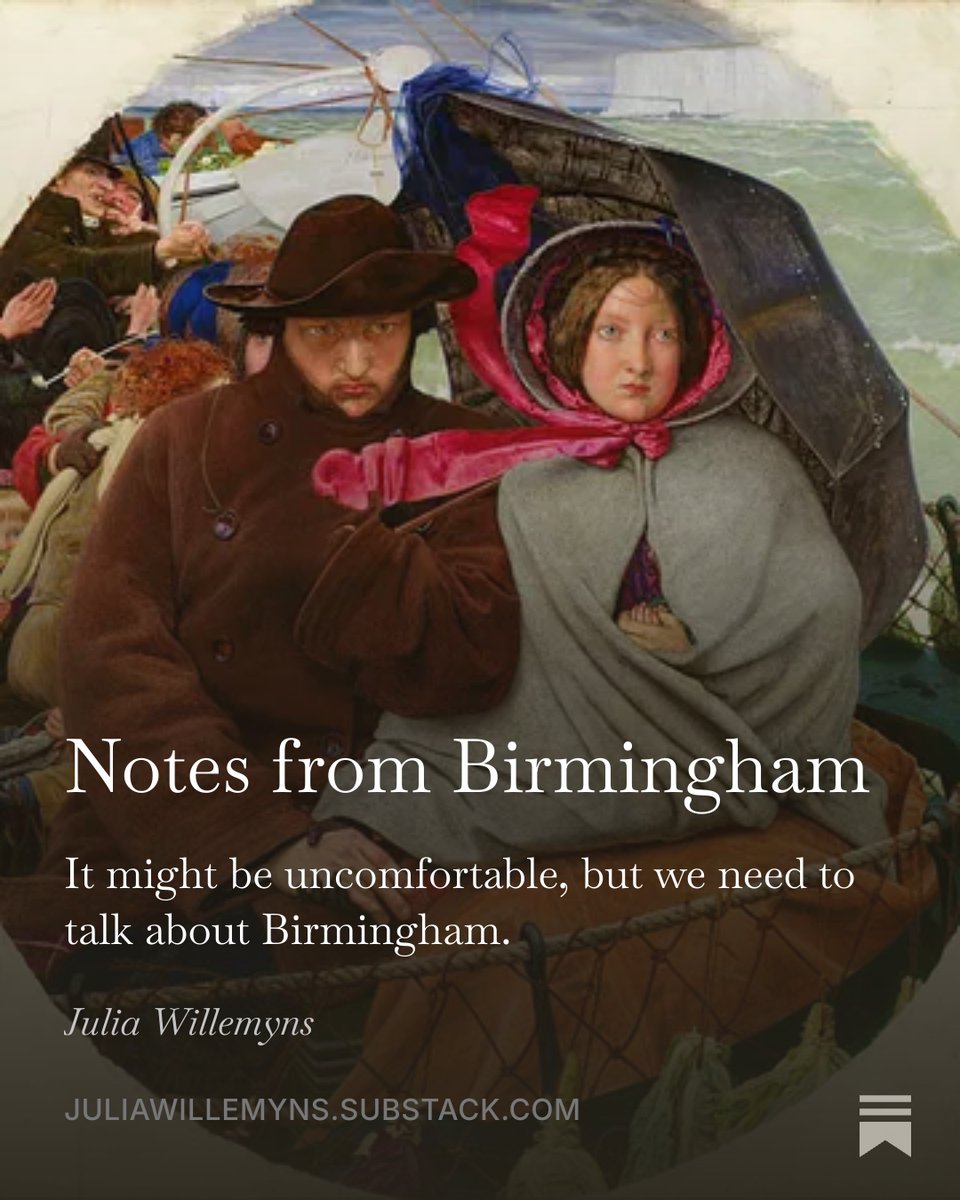
I was in Birmingham last week. I tried to explore the city the best I could. Here are my ten reflections: juliawillemyns.substack.com/p/notes-from-b…
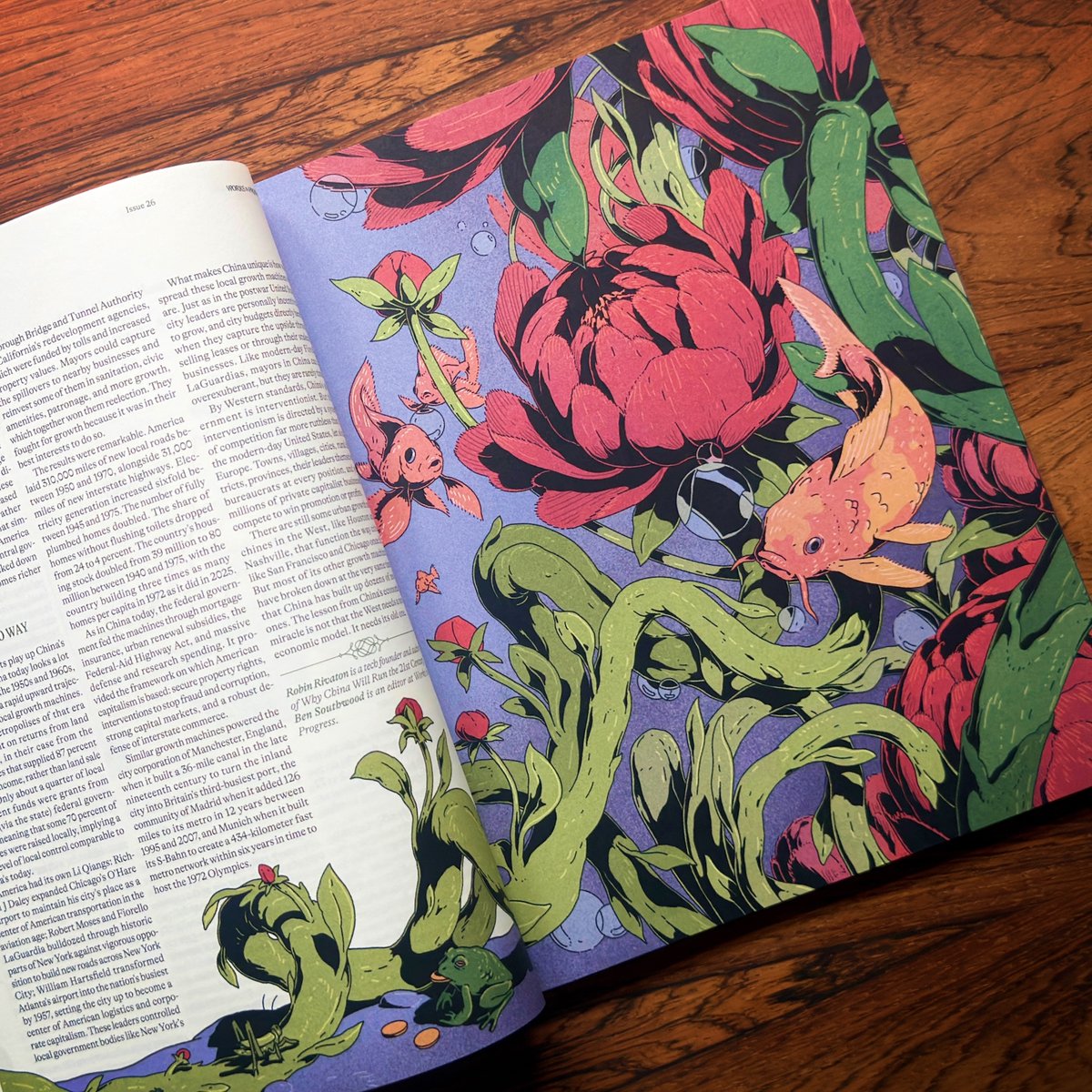
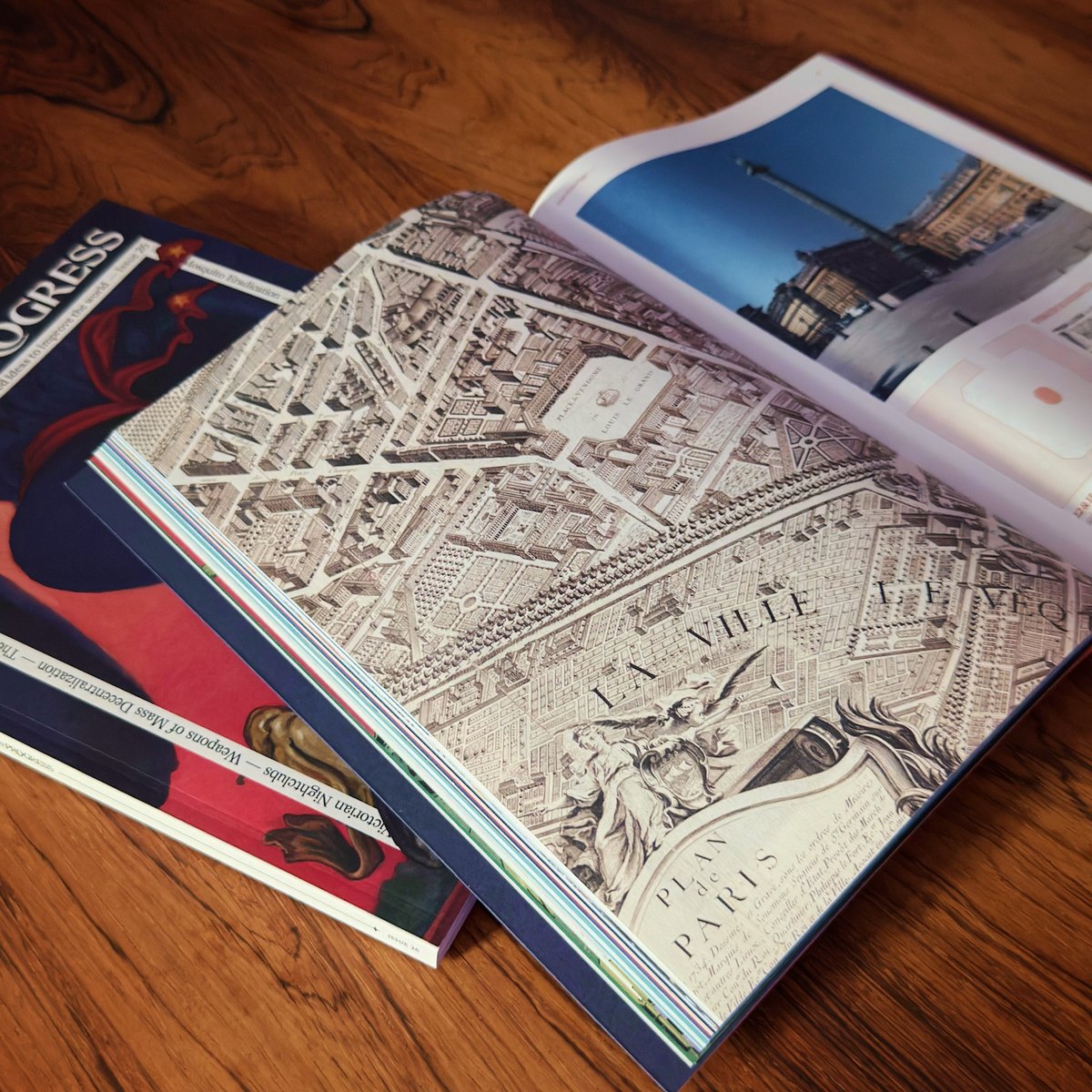
Remarkable assemblage in the new @WorksInProgMag: - @RobinRivaton and @bswud on how China's cities, and the competition between them, have driven its rise to techno-industrial preeminence, - @danwwang on Chinese and American second-tier cities, - @tylercowen on the food of Brazil, - @vpostrel on the invention of supermarkets, - @CharlesCMann on the discovery of porcelain, - @salonium on the myth of accidental scientific discovery, - Stephen Kotkin on Leninism's fatal flaw, - @owl_posting on biomedical hedge funds, - @PMArslanagic on the formula for lovable cities, - @pietergaricano on Ukraine as the future of war, - @PatRubenFitz on the Bronze Age Collapse, and - @SCP_Hughes on the social lives of hard-partying Victorian elites.

The new issue of Works in Progress, arriving with subscribers this week, is our best ever and packed with must-read pieces. Our lead essay is @RobinRivaton and @bswud on how China's cities, and the competition between them, have driven its rise to techno-industrial preeminence.



New role, who dis? x.com/i/article/2107…

Austen Allred @Austen
487K Followers 2K Following CEO Gauntlet AI: Free AI training + high-paying jobs for the smartest engineers. Will tweet as I wish and suffer the consequences. Accelerando: @kellyclaudeai
Aaron Levie @levie
3.5M Followers 964 Following ceo @box - your business lives in content. unleash it with AI
Nikita Bier @nikitabier
1.4M Followers 2K Following unemployed. former head of product @x, ex-founder @thetbhapp (acq by @meta), ex-founder @gasappteam (acq by @discord)
tobi lutke @tobi
519K Followers 2K Following Shopify CEO by day, Dad in evening, hacker at night, Aspiring comprehensivist.
Suhail @Suhail
450K Followers 710 Following Starting something new. Past: CEO & Founder @mixpanel Pizzatarian, engineer, music maker
Patrick McKenzie @patio11
201K Followers 816 Following I work for the Internet and am an advisor to @stripe. These are my personal opinions unless otherwise noted.
Alexandr Wang @alexandr_wang
820K Followers 935 Following chief ai officer @meta, founder meta superintelligence labs, founder @scale_ai. give everyone the adulthood they dreamed of in childhood
delian @zebulgar
327K Followers 961 Following space drugs and arms @vardaspace | village idiot/partner @foundersfund | porthos @hillvalleyforum

Bill Gurley @bgurley
812K Followers 2K Following Founder/President @p3institute Author: Runnin' Down a Dream, link below! Founder: Runnin' Down a Dream Foundation Former VC @benchmark Trustee @sfiscience
Jason ✨👾SaaStr.A... @jasonlk
253K Followers 2K Following GET funded ➡ $200m https://t.co/AVvPIrIdFP🦄🦄🦄🦄🦄🦄🦄 Seed/Early A AI+B2B The Agentic Life
Lenny Rachitsky @lennysan
453K Followers 3K Following Deeply researched product, growth, and career advice


Ryan Hoover @rrhoover
496K Followers 2K Following Founder of @ProductHunt. Investor at @WeekendFund. Married to @SandyBKwon. Hi! 👋🏼
Sar Haribhakti @sarthakgh
104K Followers 1K Following product & engineering comms lead @tryramp & @ramplabs. formerly @stripe
Erik Torenberg @eriktorenberg
168K Followers 4K Following General Partner @a16z. Positive-sum. Striving for a thousand year heart. Worldbuilding @mtslive @theacademysf @cosign

Tweets from Zach Wein... @zachweinberg
82K Followers 462 Following I do healthcare & tech stuff. Founder of https://t.co/uJTXjZVNJt, Flatiron Health (acq @Roche~$2b) & Invite Media (acq @Google~$81m). Invest @ https://t.co/2D00yW2Be4

jok @jokbdv6
0 Followers 58 Following
Oketcho Dasan @OketchoDasan
0 Followers 30 Following
Happyfish @SuSuYYl
1 Followers 58 Following
David Cullen @davidcullendc
0 Followers 537 Following
Paul John @PaulJohn372907
2 Followers 80 Following
Jannes Fischer @janneskjfischer
112 Followers 78 Following Angel Investments in Infrastructure & Space · P3A
Joe Fox @JF_U1F44B
19 Followers 286 Following Engineer 
Pauline Odhiambo @OdhiamboPa69609
1 Followers 80 Following
Fazilet @Fazilet72726264
0 Followers 38 Following
Hank Yang @realHankYang
0 Followers 26 Following
user @user1385179
1 Followers 178 Following
Lucy Natalie @LucyNatalioqwu
0 Followers 22 Following

Rahul Mishra @RahulMi31863010
1 Followers 44 Following

AAM ABACHADA UPDATE @AbachaUpdate
443 Followers 340 Following IG: https://t.co/DJu55euwrR FB: https://t.co/zKJLGbFUPZ WhatsApp: https://t.co/mFseScploy
JINYOUNG JUNG @JINYOUN53058141
1 Followers 21 Following
wasudeo @wasudeokj
0 Followers 21 Following
Chandu lal dungri Cha... @Chandulaldqecl
1 Followers 307 Following
@MindMoneyAI @EzekielNkasi
3 Followers 84 Following Turn your mindset into income Psychology + Money + AI Learn. Apply. Earn. Follow to grow daily
synthia @synthia22u
3 Followers 353 Following
Sandheep Rao @sandheeprao
0 Followers 14 Following
Adam Di Marco @AdamDiMarco3
3 Followers 44 Following
Michael Harding @mharding
64 Followers 357 Following Software Engineer, Digital Marketer, Photographer & Freemason
𝐓𝐎𝐏 𝐃𝐎... @TOPDOGE007
128K Followers 7K Following Analyzing Dogecoin trends, narratives and adoption | Early signals and data-driven crypto insights | DM for partnerships and promotions | Not financial advice |
Arjun Gupta @arjun8124
0 Followers 23 Following
Luke ochieng @Lukeochienilos
1 Followers 83 Following
채원희 @_wo_nyc
2 Followers 32 Following
Triin Alas @TriinAlas1
0 Followers 14 Following Senior UX designer at SEB | Shaping digital banking & fintech experience | UX workshops & mentoring
Jayden Park @JaydenParkl7
0 Followers 21 Following
John @JXPNJHN
0 Followers 34 Following
第四声 @wxcd011014
0 Followers 4 Following

Lalith Vamsi @lalith_vamsi
8 Followers 67 Following
AppCaster @RoketsSI
34 Followers 473 Following Fast Updates on SI (Superintelligence) Building with SI (Superintelligence) Just Do It!

future queen of Spain... @futurequeeg5i0
24 Followers 567 Following Envíame un mensaje por Telegram 👉👉👉https://t.co/hya4dhOv1F o por Zangi 👉3099198830 para que puedas recibir tu premio de $30,000 y tu tarjeta de fan.
Pier dei @PyeroMino
7 Followers 183 Following
Viraj Mote49 @Viraj_Mote27
2 Followers 12 Following
Rahul Gupta @RahulbeGupta
1K Followers 1K Following Developer | Salesforce | Freelancing open — DM me! 💼 Generative AI |CRM | Integration |Data Cloud
lcentralized @lcentralized
0 Followers 434 Following
yingf @yingf3a
1 Followers 47 Following
Ross Linna @RossLinna32985
266 Followers 2K Following

EmreYorgancigil @EmreYorgancigil
3K Followers 4K Following Tıp Doktoru/Neuroscience PhD/Uygarlık tarihi ve geleceğe dair :https://t.co/7qBsea5zcD
abdullahi shuaibu @abdullahibamas
0 Followers 56 Following

Daniel Gross @danielgross
407K Followers 0 Following
tylercowen @tylercowen
425K Followers 563 Following new book *Talent: How to Identify Energizers, Winners, and Creatives Around the World*, https://t.co/7bU5cTWLzc, Conversations with Tyler, The Free Press.

Jeff Weinstein @jeff_weinstein
55K Followers 8K Following product at @stripe. tiny angel investor. led @wagonhq (acq by @box) and @hyperpublic (acq by @groupon). i reply to good cold emails.
Dominik Posmyk @dominikposmyk
612 Followers 2K Following Co-founder of @quickchatai (YC S18). Reading a lot. Sharing my notes and things I find interesting.
Marcus Walker @WalkerMarcus
26K Followers 4K Following A clergyman in the Church of England in the Diocese of London. Musings in Church and State and late Roman History (and, in fact, any history).
Rhine Group @TheRhineGroup
313 Followers 0 Following We are not too late to change Europe's trajectory, if we take the right steps today.
OpenRouter @OpenRouter
155K Followers 387 Following The unified interface for LLMs. 400+ models (incl. 50+ free), the best prices, explorable data, private chat, & a unified API. https://t.co/qJG5mKrQ6j
Open Standard @openstandard
43K Followers 81 Following We’re building open stablecoin infrastructure for businesses to move money globally.
Machine Payments Prot... @mpp
8K Followers 0 Following An open standard for machine payments, co-authored by @tempo and @stripe. MPP is designed to be extensible and agnostic to any payment method.
Ruxandra Teslo 🧬 @RuxandraTeslo
32K Followers 3K Following Writer @WorksInProgMag & @Stripe | Clinical Trial Abundance | long-form https://t.co/ipFMYGuR84
Privy @privy_io
56K Followers 0 Following Wallet infrastructure for winning teams. Powering 160M+ accounts and billions in volume with APIs and SDKs for onchain payments and asset management.
Bridge @Stablecoin
23K Followers 29 Following Bridge is an entirely new payments platform, built with stablecoins, to simplify global money movement. Learn more: https://t.co/5kh2t2HUzp


Pliny the Liberator �... @elder_plinius
251K Followers 1K Following ⊰•-•⦑ latent space steward ❦ prompt incanter 𓃹 hacker of matrices ⊞ breaker of markov chains ☣︎ si danger researcher ⚔︎ bt6 ⚕︎ building @LYSIOS ⦒•-•⊱
Works in Progress @WorksInProgMag
32K Followers 36 Following Works in Progress is a magazine of new and underrated ideas to improve the world. Subscribe to our new print edition now. We are proud to be part of @Stripe.
IFP @IFP
23K Followers 59 Following A think tank for accelerating scientific, technological, and industrial progress. Follow our team: https://t.co/CC0MxWfh3X
Arc Institute @arcinstitute
48K Followers 75 Following A full-stack institute for AI and biology research.

Silvana Konermann @SKonermann
10K Followers 524 Following Cofounder @arcinstitute and Assistant Professor @Stanford. HHMI Hanna Gray Fellow. CRISPR, RNA and Alzheimer’s via @salkinstitute, @MIT and @eth
NWS Bay Area 🌉 @NWSBayArea
265K Followers 662 Following Official Twitter account for the National Weather Service San Francisco Bay Area. Details: https://t.co/ASDrLwF1Yj
Megan McArdle @asymmetricinfo
111K Followers 836 Following Columnist at the Washington Post. Opinions my own. Email me: Megan.McArdle -at- https://t.co/0v35DOybb0 Buy my book, The Up Side of Down https://t.co/awicv1MdkX
𝔊𝔴𝔢𝔯𝔫 @gwern
107K Followers 115 Following Internet besserwisser; pedantic, mean reply guy. 𝘞𝘢𝘵𝘢𝘴𝘩𝘪 𝘬𝘪𝘯𝘪𝘯𝘢𝘳𝘪𝘮𝘢𝘴𝘶! (Follow requests ignored due to terrible UI.)
Nadia Asparouhova @nayafia
30K Followers 388 Following publishing @asteriskmgzn // books: Working in Public (open source) + Antimemetics (ideas that don’t spread)
Tamara Winter @tamarawinter
32K Followers 2K Following Publishing @stripepress | Creator of TACIT, a mini-documentary series following master craftspeople at work & Beneath the Surface, an infrastructure podcast
Stewart Brand @stewartbrand
57K Followers 538 Following Co-founder of The Long Now Foundation--which takes no sides. In this forum, as a private person, I do take sides occasionally.
Ross Douthat @Douthat60
228K Followers 455 Following 60 Minutes correspondent, Free Press columnist, author of Believe: https://t.co/knRQn31ehz and The Falcon's Children: https://t.co/NgELacKn0n
Stripe @stripe
294K Followers 558 Following Building programmable financial services. Incorporate: @atlas. Help: @stripesupport. Read: @stripepress @WorksInProgMag. Status: @stripestatus.You might like