

Riskiana @riskicoder
Bind knowledge with writing Joined January 2025-
Tweets341
-
Followers2
-
Following92
-
Likes94

🚀 Kubernetes Helm — the cheat sheet every DevOps engineer needs! Managing Kubernetes deployments manually can get messy. Helm makes it easier to package, configure, version, and deploy applications using reusable Charts. Here's what every Kubernetes engineer should know 👇 🔹 Charts & Releases 🔹 "Chart.yaml" vs "values.yaml" 🔹 Helm templates 🔹 Essential Helm commands 🔹 Install, upgrade & rollback 🔹 Managing dev, staging & prod environments 💡 Pro tip: Master "helm upgrade" and "helm rollback" before managing production deployments. Save this cheat sheet for your next Kubernetes project! 🔖 #Kubernetes #Helm #DevOps #SRE #CloudNative

4 CORE CONCEPTS TO MASTER AI SYSTEM DESIGN 1. AI Fundamentals, LLMs & Model Architecture 2. RAG, Embeddings, Vector Databases & Knowledge Systems 3. AI Agents, Tool Calling & Multi-Agent Orchestration 4. AI Infrastructure, Scalability, Evaluation & Production Deployment Grab AI System Design Handbook: codewithdhanian.gumroad.com/l/zdluvb


Interviewer: You have two beans implementing the same interface. Your application fails to start with NoUniqueBeanDefinitionException. How would you resolve this without removing either implementation? When would you use @primary versus @qualifier?

Handbook on Understanding Harness Engineering for AI Agents [48-page PDF]: drive.google.com/file/d/1PT-P2P…


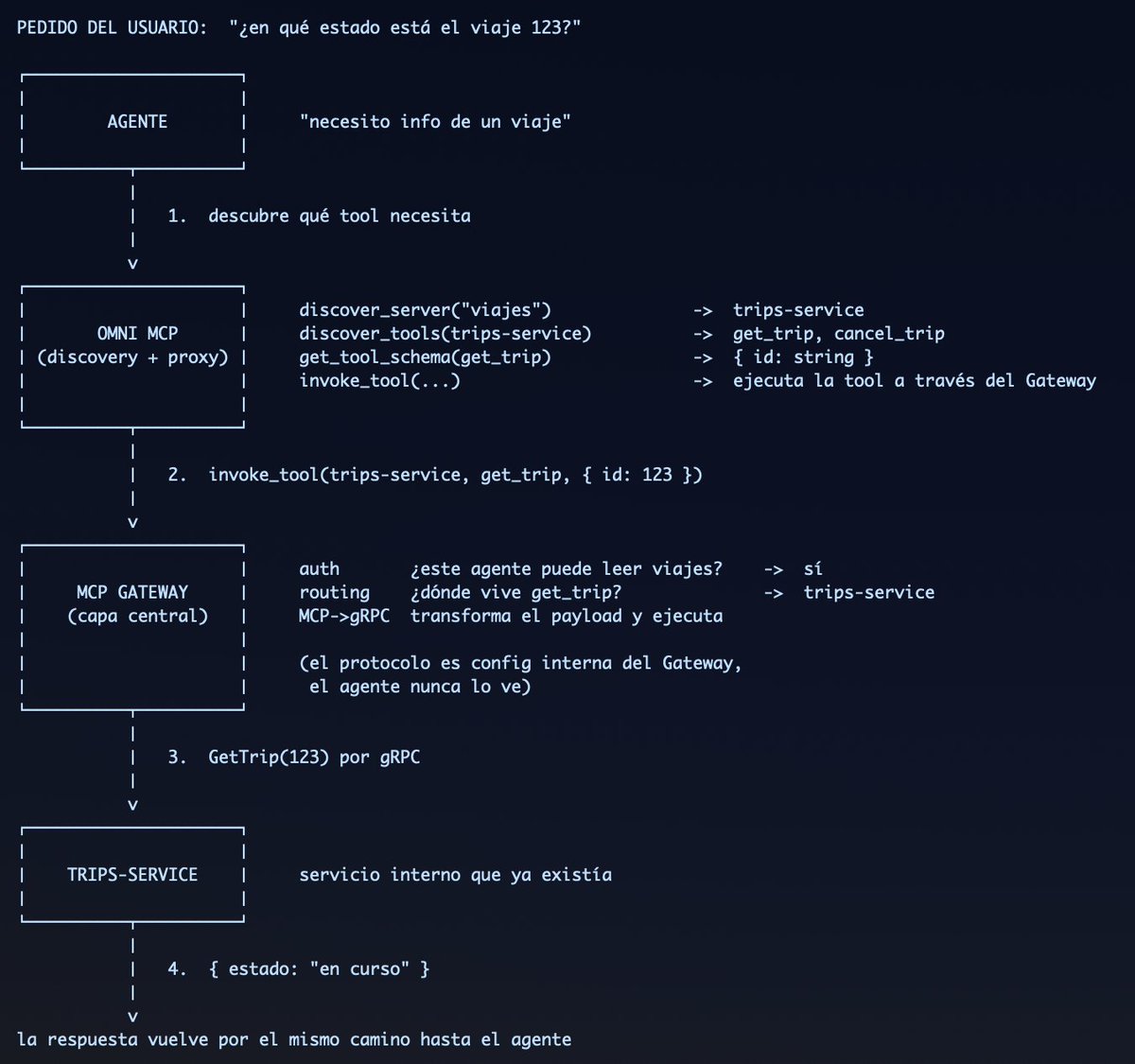
Uber publicó cómo armó su infraestructura de MCP y hay varias ideas muy buenas acá. imaginate una empresa con miles de servicios internos y muchos equipos conectando agentes a esos sistemas por su cuenta. cuando eso empieza a crecer, terminás con tooling fragmentado, infra duplicada, distintas formas de exponer tools y poca consistencia en seguridad, discovery y operación. por eso Uber hizo un MCP Gateway: una capa central entre los agentes y sus servicios internos. el agente habla MCP y el gateway se encarga de routing, permisos, ejecución y de traducir las llamadas a HTTP, gRPC o TChannel según corresponda. como Uber ya tenía miles de APIs internas, también hicieron AutoCrawler: recorre sus definiciones, detecta métodos y schemas y genera MCP tools automáticamente. incluso usan un LLM para mejorar las descripciones. hoy tienen +800 MCP servers y +5000 tools. y ahí aparece otro problema: no podés cargar todas esas definiciones en el contexto del modelo. para eso crearon Omni MCP. en vez de pasarle miles de tools al agente, este va descubriendo qué server necesita, qué tools tiene disponibles, carga el schema de la correcta y recién ahí ejecuta. me parece un muy buen ejemplo de cómo cambia la arquitectura cuando los agentes pasan de usar unas pocas tools a trabajar con miles. terminás necesitando algo muy parecido a un API Gateway para agentes.


An article for everyone who ships, buys, or signs off on software built on large language models (LLMs): engineers, product managers, and the CEO. Written in plain language, from the big picture down to the details. x.com/i/article/2106…

FORGET UDEMY. FORGET COURSERA. FORGET PAID COURSES. CLAUDE can now teach you anything for free. Use these prompts and level up your learning in 2026:

Do yourself a favor! – Learn AI Engineering – Build an Agent that solves a real problem – Give it tools, context, and MCP – Use evals to test it actually works – Deploy it and share code on GitHub – Add this to your resume You won’t believe how many job offers you'll get.

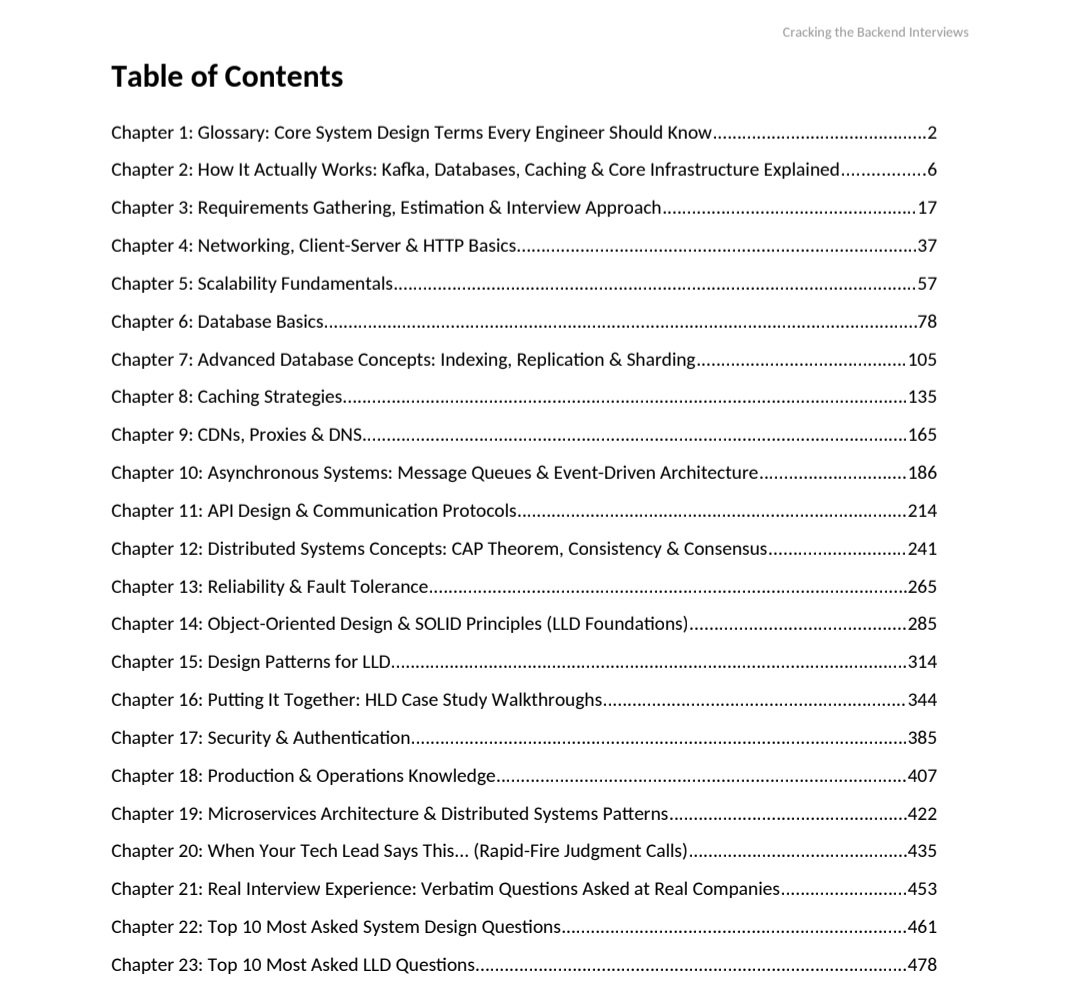
Cracking The Backend Interviews... topmate.io/interviewswith…

It’s GOLD for learning Networking for Cloud & DevOps
Networking Playbook for Cloud & DevOps (12 Days) techfusionist.substack.com/p/12-days-netw…

if i had 6 months to become an AI engineer from zero i'd do this Stage 1: the boring foundations - learn: python, git, the terminal, http and json, basic sql, fastapi - practice: build a cli tool that calls a public api and writes clean json to disk - why: ai engineering is software engineering first, and every stage below assumes you can ship a working endpoint Stage 2: llm app development - learn: prompting, structured outputs with pydantic, tool calling, streaming, conversation state, token cost - practice: build an invoice parser that returns a typed python object, then give a model 3 tools and let it pick - why: this is the actual job, and most people skip straight past it to agents Stage 3: rag, properly - learn: embeddings, chunking, vector stores, metadata filtering, reranking - practice: ingest 20 pdfs and ship an endpoint that returns a cited answer from the top 5 chunks - why: most rag failures are retrieval failures, so whoever can debug retrieval gets paid Stage 4: agents, workflows and evals - learn: the agent loop, tool descriptions, state, retries, and when an agent is the wrong call - practice: build one agent with no framework at all, just the api, 3 tools and a while loop - why: a chain of 3 fixed calls beats an agent that might make 3 calls, and knowing which one you need is the senior part Stage 5: deployment and reliability - learn: docker, background jobs, auth, rate limits, tracing with langfuse, caching, cost control - practice: containerize your rag app with a vector db and redis, then put a hard daily spend cap on it - why: this is where most people stall, they can demo but they can't survive real traffic at 2am Stage 6: pick one lane - learn: product engineering, applied ml, or business automation - practice: ship 2-3 projects a stranger can open and use without you explaining anything - why: six months makes you dangerous in one direction, not average in three you don't need to train models you need to build systems on top of them, and that's what companies are actually paying for i wrote the full version of this with every resource and link for each stage so, if you're beginner and skipped this article 6 months ago, read below:
Jev Decision Services Architecture


May you get married to someone who sees you as an Amanah from Allah, not a burden. 🤲🏻

Jev Founder, Diogo Almeida, just released a 12-page PDF on how to use Jev with LLMs It is more useful than most paid AI courses: this is a 10-step blueprint on how to build a faster, cheaper and more controllable AI system around Claude, Codex, Grok or any other LLM: step 1 → split the responsibilities: the LLM generates, Jev makes bounded semantic decisions and deterministic code keeps authority step 2 → build the state: give Jev the current request, relevant evidence, policy and proposed action instead of sending the entire conversation step 3 → choose the right primitive: Choice selects a route, Score evaluates an ordered rubric and Noul returns the probability that a statement is true step 4 → replace giant evaluation prompts with atomic questions: intent, urgency, evidence, risk and scope become separate typed decisions step 5 → put Jev before the LLM: select the context, tools, provider and workflow before paying for an expensive generative call step 6 → give the LLM a bounded job: once Jev selects the route, the model receives only the instructions, files and tools required for that branch step 7 → put Jev after the LLM: check whether the result answers the request, uses sufficient evidence and stays inside the permitted scope step 8 → route by confidence: high-confidence low-risk cases proceed automatically, uncertain cases request more context and consequential actions go to review step 9 → batch independent decisions: ask multiple Choice, Score and Noul questions over one shared state instead of creating another LLM call for every judgment step 10 → record the complete decision receipt: state version, question, probabilities, selected route, model, latency, outcome and human override most AI courses teach you how to write a bigger prompt this 12-page guide teaches you how to build the control system around every prompt the result: smaller contexts, fewer unnecessary LLM calls, safer tool execution and decisions you can actually inspect, test and improve Send this PDF and the original Jev article to Claude Code or Codex and start rebuilding one expensive LLM decision at a time ↓
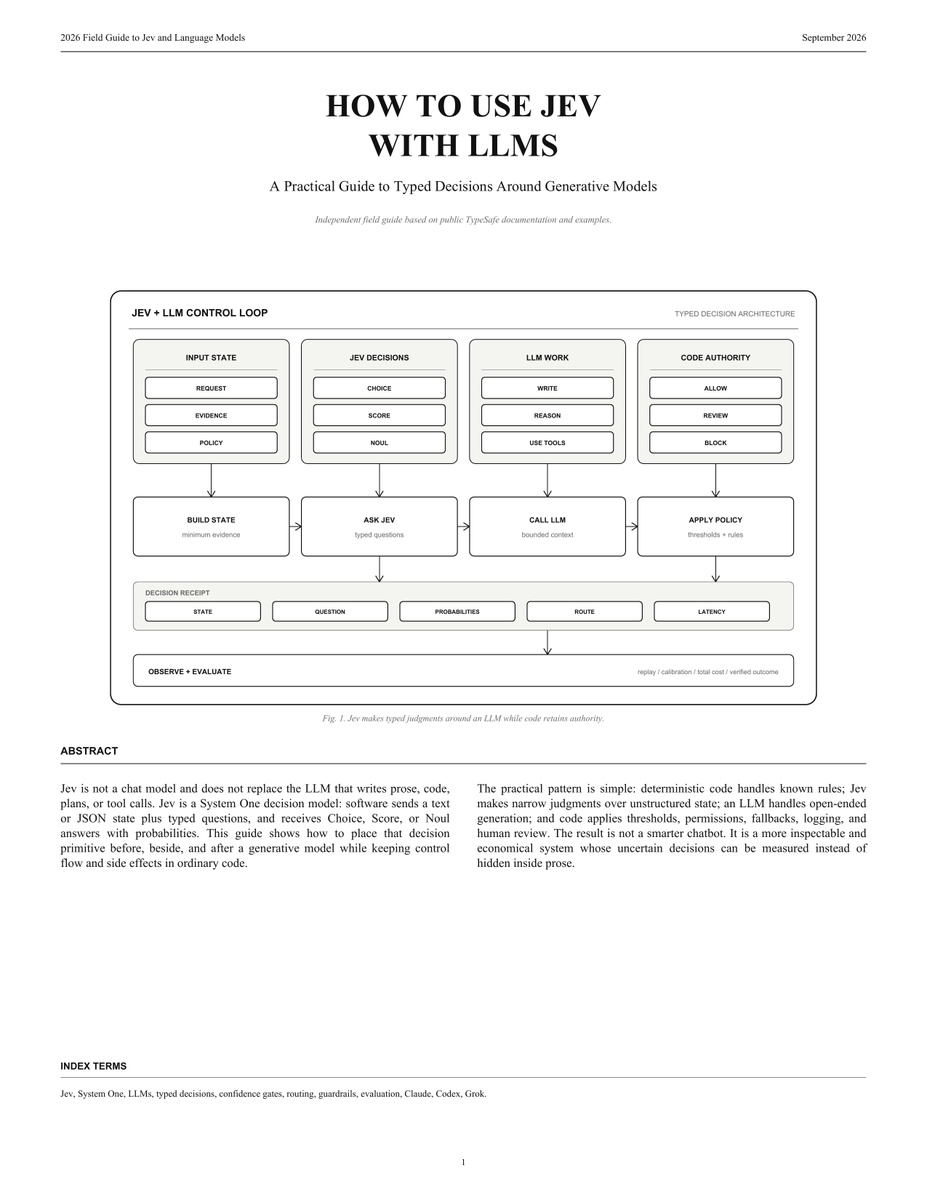
Most AI agents waste tokens on decisions that never needed text Jev turns routing, scoring, and verification into a fast decision layer I broke down the architecture most agent builders are still missing ↓ x.com/i/article/2101…


Anatomy of a Terraform project 🚀 Still confused about Terraform files and their directory structure? Here are the Terraform files you need to understand: • 𝗺𝗮𝗶𝗻.𝘁𝗳: Defines resources and module calls. • 𝘃𝗮𝗿𝗶𝗮𝗯𝗹𝗲𝘀.𝘁𝗳: Declares the input variables for the configuration. • 𝗼𝘂𝘁𝗽𝘂𝘁𝘀.𝘁𝗳: Exposes resource values like IDs and ARNs. • 𝘁𝗲𝗿𝗿𝗮𝗳𝗼𝗿𝗺.𝘁𝗳𝘃𝗮𝗿𝘀: Supplies the actual values for those declared variables. • 𝗯𝗮𝗰𝗸𝗲𝗻𝗱.𝘁𝗳: Configures the remote state backend like S3 or Terraform Cloud. • 𝗺𝗼𝗱𝘂𝗹𝗲𝘀/: Folder that holds reusable pieces like network and compute. • 𝘁𝗲𝗿𝗿𝗮𝗳𝗼𝗿𝗺.𝗹𝗼𝗰𝗸.𝗵𝗰𝗹: Records selected provider versions and checksums. • 𝘁𝗲𝗿𝗿𝗮𝗳𝗼𝗿𝗺.𝘁𝗳𝘀𝘁𝗮𝘁𝗲: Tracks resources managed by Terraform and their state. Once you understand the structure, reviewing changes and debugging the plan output becomes much easier. So when you join a project or pick up someone else's Terraform code, spend time understanding the layout before you run apply. We have a detailed guide to help you understand Terraform modules and how to structure them properly. 𝐑𝐞𝐚𝐝 𝐢𝐭 𝐡𝐞𝐫𝐞: devopscube.com/terraform-modu… 𝗡𝗼𝘁𝗲: Files such as main.tf, variables.tf, and backend.tf are naming conventions. Terraform reads all .tf files in the working directory as part of the same configuration. How do you structure your Terraform projects? #terraform #iac


One GitHub repo can teach you more about Kubernetes than 50 tutorials. Build a cluster by hand instead: github.com/kelseyhightowe… No scripts. No shortcuts. You'll understand what every managed service is doing for you and never fear a cluster again.


Shairr @Shairr3J38
79 Followers 3K Following
Bruno Souza @brjavaman
17K Followers 759 Following Since 1995, helping software developers improve their careers and work on cool projects with great people! @Java Evangelist @JCP_ORG Executive @SouJava Leader
Ivar Grimstad @ivar_grimstad
6K Followers 949 Following Java Champion | Jakarta EE Developer Advocate | The guy with the Duke tattoo | @JakartaEE @EclipseFdn https://t.co/6ge0KSy9XT
Kubernetes @kubernetesio
328K Followers 86 Following #Kubernetes: open source production-grade container orchestration management. #CNCF #K8s
Otavio Santana @otaviojava
10K Followers 984 Following Award-winning Software Architect. Helping organizations make better technology decisions through strategy, architecture & open source leadership. Java Champion.
Reza Rahman ☮️ @reza_rahman
12K Followers 264 Following Enterprise Java technologist, consultant, leader, speaker. Past key member of Oracle’s and Microsoft’s Java teams. Anti-racist. Account and views mine only.
A N M Bazlur Rahman �... @bazlur_rahman
4K Followers 797 Following Java Champion 🏆 Empowering Developers through Speaking 🗣️ Writing ✍️ Mentoring 🤝 & Community Building 🌍 Published Author 📖 Editor @InfoQ, @foojayio
Next.js @nextjs
296K Followers 15 Following The React Framework – created and maintained by @vercel.
Rustam Mehmandarov @rmehmandarov
4K Followers 890 Following Passionate computer scientist. One of @Java_Champions, @GoogleDevExpert for Cloud, Docker Captain. Public speaker. Ex-leader of JavaZone and Norw. JUG – javaBin
Mary Grygleski @mgrygles
5K Followers 3K Following EmergTech-Architect-Advocate🥑🤖 | 🌎 | ex-#IBMer |@Java_Champions |@CJUG Prez | @_ai_collective-Chicago && RegionalDir | Truth-seeker✝️ & Live+Tech-4-Goodness
Emily Jiang (@emilyji... @emilyfhjiang
5K Followers 1K Following Java Champion, MicroProfile guru, Book author, IBMer, runner, mum, passionate about Java +MicroProfile+Jakarta EE, conference speaker. Tweets are my own.
GitHub @github
2.7M Followers 334 Following The AI-powered developer platform to build, scale, and deliver secure software.
JavaScript Daily @JavaScriptDaily
595K Followers 177 Following Sharing links, news, and humor about JS, TypeScript, and related front-end stuff 💛 Not affiliated with Oracle or Larry Ellison.

Paul Bakker @pbakker
8K Followers 386 Following Staff Engineer at Netflix in Java Platform - Java Champion - Co-author of "Java 9 Modularity" - https://t.co/snQ4t62Npb
GeeksforGeeks | Learn... @geeksforgeeks
88K Followers 118 Following Become a better version of yourself this summer with GfG! 💻💡
Node.js @nodejs
913K Followers 599 Following The Node.js JavaScript Runtime. 🐢🚀 Need help with Node.js? We've got a repo for that: https://t.co/BaCSQqhNRO
Vue @vuejs
324K Followers 525 Following Progressive JavaScript framework for building modern web interfaces. Created by @evanyou, maintained by https://t.co/GBCO6zpR6W.
TypeScript @typescript
424K Followers 49 Following TypeScript is a language for application-scale JavaScript development. It's a typed superset of JavaScript that compiles to plain JavaScript.
Kube Architect @K8sArchitect
80K Followers 1 Following News and links on architecting and developing apps on Kubernetes curated by the @Learnk8s team Mastodon: @[email protected]

The Pragmatic Enginee... @Pragmatic_Eng
51K Followers 4 Following Big Tech and startups, from the inside. The #1 technology newsletter on Substack. Sign up at https://t.co/MPNdQSVnwV. Podcast: https://t.co/nVOulBGYoh

Mayank Tayal @Ai_here202
41K Followers 99 Following Here's your new Ai generation model || learn everyday about Ai , tech & Finance || DM for Collab📩- [email protected]
Makakmayum @makakmayum_sid
7K Followers 75 Following Author of BESTSELLING Java interview ebook | Crack that Java Interview | Java+Microservices+System design stuff
Shraddha Bharuka @BharukaShraddha
36K Followers 191 Following Content Creator | Helping brands grow organically | Full-Stack Dev | Built AI tools & real-time apps
Karen Hao @_KarenHao
86K Followers 1K Following NYT bestselling author of EMPIRE OF AI: https://t.co/wh5mCWc2mo. ai reporter. american national magazine award winner. in @MorePerfectUS @theatlantic @wsj @techreview
freeCodeCamp.org @freeCodeCamp
1.2M Followers 157 Following We're a community of millions of people who are learning math, programming, and computer science together. A 501(c)(3) public charity. Tweets by @abbeyrenn.
Hadith of the Day @Hadithoftheday
2.7M Followers 1K Following Providing daily drops of inspiration. Daily newsletter: https://t.co/hmgatIB4Nk Love space travel 🌍 tennis 🎾 cooking 🧑🍳
DevopsCube @devopscube
12K Followers 10 Following DevOps, MLOps, and Cloud tips & Deep Dives (300 K Community)
Jeanne Boyarsky @jeanneboyarsky
5K Followers 203 Following Software developer in NYC, Java Champion, FIRST FRC mentor, CodeRanch moderator, Toastmaster. Author of OCP Java Certification Study Guides and Real World Java
Alex Xu @alexxubyte
295K Followers 611 Following Co-Founder of ByteByteGo | Author of the bestselling book series: ‘System Design Interview’ | YouTube: https://t.co/9gPSJSrtPU
Mala Gupta @eMalaGupta
12K Followers 660 Following JavaChampion. Speaker. Books: https://t.co/KlnHGpPrql. Co-lead @WWCode_Delhi, @DelhiJUG. DevNexus Rockstar!
Dan Vega @therealdanvega
27K Followers 7K Following 🍃 Spring Developer Advocate @Broadcom ☕️ Java Champion 📹 YouTuber https://t.co/1qzY9JT3ct 📗 Author https://t.co/FRQ7El2qJK 🎙️ Podcast https://t.co/z0vkODhi20
Dhanian 🗯️ @e_opore
71K Followers 3K Following SoftwareDev. Roadmaps,Cheatsheets, Projects with Source Code ,AI & Resources.Learn with me.Coding Ebooks: https://t.co/g835vCPNQA.
🇯🇵🇧🇷🇺�... @yanaga
13K Followers 876 Following Empowering developers worldwide as Staff Developer Relations Engineer, Wallet Lead, @Google. Java Champion and former 7x Microsoft MVP. Opinions are my own.
Martin Stefanko @xstefank
831 Followers 581 Following Quarkus Core Engineer @IBM, @BrnoJUG leader, @QuarkusIO, @smallrye_io, @MicroProfileIO, author https://t.co/UIv3yfZzJ3, opinions are my own https://t.co/A4ekRQpKxL
Rafael del Nero @RafaDelNero
16K Followers 623 Following Java Champion helping mid-to-senior Java developers build international careers. 25+ mentee results in 15+ countries. ↓ Apply for a Career Diagnosis ↓
Rodrigo Graciano @dev... @rodrigograciano
3K Followers 535 Following Father • Married to @ManuGraciano • @nyjavasig JUG leader • @Java_Champions • Public speaker • https://t.co/QlcK2JNUW3 • 🇧🇷🇺🇸 • opinions are my own
Donald Raab @TheDonRaab
10K Followers 57 Following Java Champion. Creator of @EclipseCollect. Author of Eclipse Collections Categorically (https://t.co/ARBW7MPAE1). 🦋 TheDonRaab Opinions are my own.
Abhinav Pandey 🍀 @Abh1navv
5K Followers 442 Following Senior Software Engineer, Technical Writer. Saving the world by all memes possible.
Simon Martinelli @simas_ch
10K Followers 2K Following Creator of the AI Unified Process. Java Champion, Vaadin Champion, Oracle ACE Pro, Author, Speaker, Programming Architect, and Lecturer.
Swapna Kumar Panda @swapnakpanda
229K Followers 200 Following | Tech Writer, Educator | Python, Java, JavaScript, SQL | DSA, Development | Free Resources, AI Tools | Other Version: @therealswapna | Building @JabardastDEV |
Java at Microsoft @JavaAtMicrosoft
16K Followers 281 Following Java usage at Microsoft spans from Azure to Minecraft, across LinkedIn to Visual Studio Code, and beyond! We use more Java than one can imagine.
Shalini Goyal @goyalshaliniuk
12K Followers 195 Following Executive Director @ J.P Morgan, Ex-Amazon || 130K on LI || Engineering and AI || Collab ➡️ [email protected]
Brian Goetz @BrianGoetz
66K Followers 210 Following Java Language Architect at Oracle. Author, Java Concurrency in Practice (https://t.co/ddAm2rKwpE). Also, cats.
Venkat Subramaniam @venkat_s
67K Followers 417 Following Programmer, author, speaker, founder Agile Developer, Inc., co-founder of @dev2next Conference, professor @CSatUH
Ayush Shrivastava �... @ayshriv
3K Followers 641 Following Backend Engineer building AI-powered products with Java, Spring Boot & Angular. SaaS • Cloud Architecture • AI Agents • Developer Experience
Gunter Rotsaert @mydevlprplanet
3K Followers 224 Following Senior Systems Engineer @TriOpSys ⚡ Blogger ⚡ Musician ⚡ Belgian🇧🇪 living in Holland 🇳🇱 Enthusiastic about software development, mainly Java ☕ oriented.

Java StackOverflow @StackJava
20K Followers 9 Following StackOverflow feed of Java questions matching certain criteria.You might like


















